From Dallas to Times Square: Heisman Trophy campaigns look to make an early impact

NEW YORK -- Few people understand the unique marketing power of Times Square better than Robert Burck.
Muscled, goateed and impressively tan, the 55-year-old has operated his business from the five-block sliver of Midtown Manhattan for the past 28 years, forging a global brand that has taken him to faraway places such as Australia, Japan and Daytona Beach, Florida. Leaning into the undeniable forces of one of the world's busiest pedestrian intersections and a famous pair of tighty whities, he pulls in more than $200,000 annually in tips alone, by his own estimation.
Today, Burck, better known as the Naked Cowboy, is standing on the corner of Seventh Avenue and West 47th Street doing what he does 300-plus days a year: flexing his biceps, strumming his guitar and snapping photos with tourists, surrounded by all of Times Square's other ever-present fixtures. There are billboards for Broadway mainstays "Aladdin," "Wicked" and "The Lion King'; sprawling advertisements for Coca Cola and M&M's; and street performers dressed as Elmo, Spider-Man and King Kong.
After nearly three decades as the Naked Cowboy, Burck explains, the unrelenting churn of promotional activity in the area tends to blend together.
"It's all a wash for me," he says.
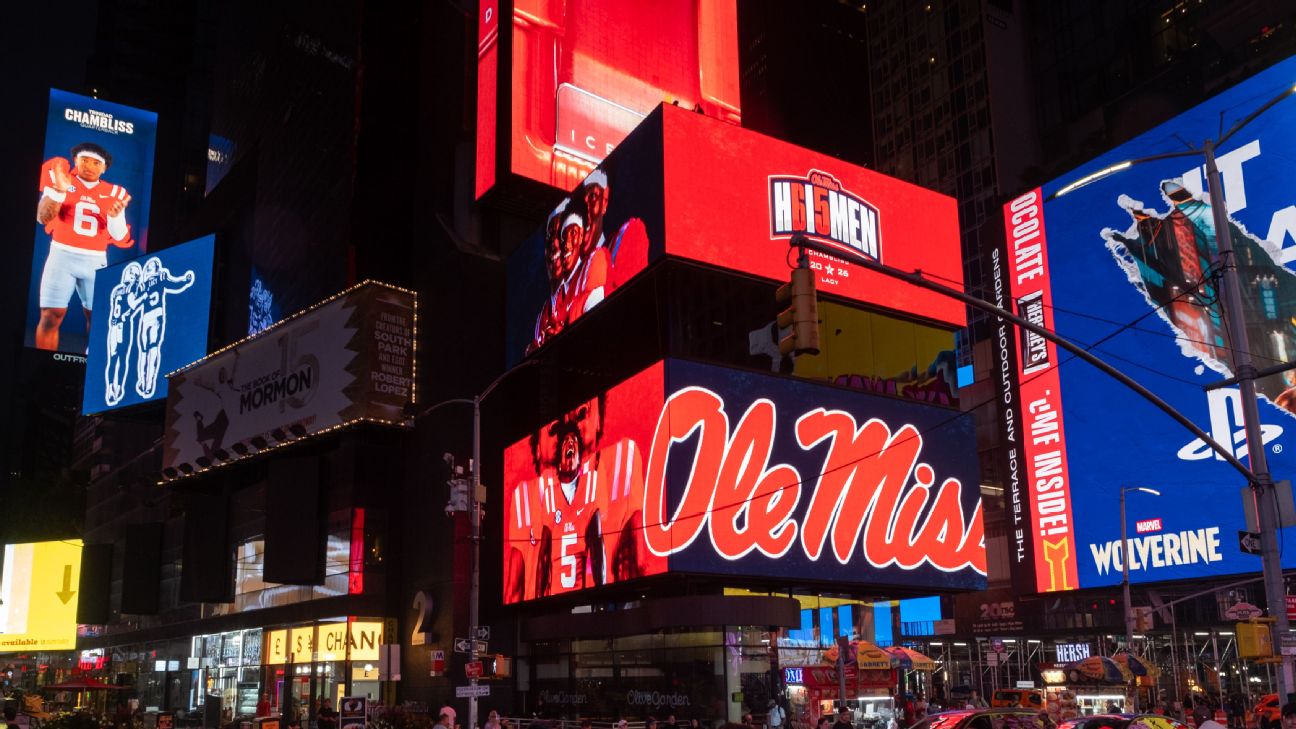
So, Burck didn't initially notice when Ole Missquarterback Trinidad Chambliss and running back Kewan Lacy showed up on a pair of 96-foot-tall digital billboards in Times Square on Aug. 24. Part of a two-week promotional residency at the center of the nation's most populous city, the arrival of the star duo was part of the latest phase of the school's aggressive preseason Heisman Trophy campaign built around Chambliss, one of the breakout stars of the Rebels' 2025 season, and Lacy, back this fall after he finished as the nation's third-leading rusher.
Equipped with two of the sport's most exciting returning offensive talents, Ole Miss has joined college football's rich and storied history of vibrant Heisman Trophy campaigns. After planting a flag in Times Square, the school followed this week with a partial takeover of the Las Vegas Sphere, set to run through Saturday in the lead-up to the No. 9 Rebels' season opener against No. 24 Louisville at Nashville's Nissan Stadium on Sunday (7:30 p.m. ET, ABC).
"You can't put a price tag on that type of publicity," Ole Miss associate athletic director Drew Ingraham said. "For us, it was a question of where can we make the biggest statement? Where can we get the most eyes? The goal was not only to promote Trinidad and Kewan but also to put the University of Mississippi and Ole Miss athletics at the forefront of college athletics too."
Spiritually, the Rebels' strategic campaign fits squarely within the long celebrated tradition of Heisman hype efforts, a history that includes Joe Theismann's name change at Notre Damein the 1960s, leaves for Ryan Leaf at Washington Statein 1997 and Oregon's "Joey Heisman" pitch in 2001, when the Ducks erected an 80-foot-by-100-foot billboard of quarterback Joey Harrington outside New York's Madison Square Garden.
Yet, Ole Miss' preseason marketing blitz, and similar politicking at SMUthis summer for quarterback Kevin Jennings, also offers a glimpse into the contemporary goals, incentives and realities beneath the surface of the modern Heisman campaign. Why did the Rebels take the Heisman candidacies of Chambliss and Lacy 1,100-plus miles from Vaught-Hemingway Stadium and into the relative college football desert of New York City? Burck understands perfectly.
"This place is insidious," the Naked Cowboy says. "It's the beauty of Times Square. Everything spreads from here."
OLE MISS WASN'T the only school to launch a Heisman campaign this summer or even the only college football program to consider a New York City installation in 2026. Not long after Jennings decided to return for a fifth season at SMU, officials in the Mustangs' athletic department began ideating on the right campaign to build around the school's senior signal-caller.
Fundamentally, every Heisman campaign is an act of storytelling. In this case, Jennings' hometown roots as a native son of Dallas and his jersey number (7) made for a natural pairing. In the early planning phases of what became the "K7NG OF DALLAS" campaign, SMU sports information director Clark Williams said the program briefly contemplated a billboard in the Greenpoint neighborhood of Brooklyn, roughly seven miles from the Heisman Trust's lower Manhattan offices.
Instead, the Mustangs opted for a more traditional campaign, at least primarily. SMU coach Rhett Lashlee showed up to ACC Kickoff last month wearing a "Jennings for Heisman" T-shirt; ACC commissioner Jim Phillips got one too. This week, the program debuted a billboard in a prominent area of Dallas featuring Jennings and a fresh tag line: "The K7NG RETURNS".
In the midst of SMU's preseason push for Jennings, the messaging around a new, $150 million building on campus was created with equal intention. In July, the Mustangs announced that a soon-to-be constructed athletic recovery center, funded by alumni donors, will be named after Jennings, an unprecedented honor for a current student-athlete. The timing was no accident.
"A campaign like this in 2026 involves so many elements, from social media to branding," Williams said. "All of those pieces play a role in vying for the Heisman. Some of it's direct, like launching the Heisman campaign itself. And then there's these indirect elements, like the recovery center. That announcement, in and of itself, wasn't a Heisman moment. But we knew that that part of Kevin's story would help drive his campaign."
While Ole Miss and SMU have reached new frontiers in 2026, the broader arc of the Heisman campaign has been defined as much by colorful gimmicks as its history of innovation.
One of the first recognized efforts sprouted at Oregon Statein 1962. Concerned that national media members were missing out on Beavers quarterback Terry Baker on the West Coast, Oregon State sports information director John Eggers began mailing updated stats to national media members weekly. Baker ultimately won the Heisman Trophy by a thin margin of 89 votes.
A year later, Navy's athletic department sent writers across the country a four-page pamphlet with information on the eventual 1963 Heisman winner entitled "Meet Roger Staubach". In 1977, Heisman hype yielded a revolutionary statistic. Resistant to running a formal campaign for Texasrunning back Earl Campbell, Longhorns sports information director Jones Ramsey instead pioneered a new metric to showcase Campbell's excellence: yards after contact.
"Initially, campaigns fit a very specific purpose," Heisman historian Chris Huston said. "The games weren't on TV. It took a long time for players to penetrate the consciousnesses of the media and the voters, so programs went to work on getting their star player's names out there."
Promotional gimmicks -- such asBYU'scardboard ties for Ty Detmer in 1990, toy cars for DeAngelo Williams at Memphis in 2005 and an endless stream of bobbleheads -- came later. And over time, Heisman campaigns became shaped by the evolving media and technologies of the time.
Barred from televised games in 1995 due to NCAA probation, Texas A&Mleaned into a relatively novel medium: the internet. That fall, the Aggies built a primitive website to boost the candidacy of Leeland McElroy. The running back started the 1995 season strong, but a subsequent ankle injury and early-season losses to Colorado and Texas Tech stifled his campaign.
"We jumped on the superhighway of information and got stuck in a cul-de-sac," said former longtime Texas A&M sports information director Alan Cannon.
In 2004, Huston, then working in the sports information department at USC, helped launch a weekly blog for the Trojans' eventual Heisman winner, quarterback Matt Leinart. In 2012, Cannon and his staff at Texas A&M were among the earliest to harness the power of social media for quarterback Johnny Manziel's campaign. In 2018, Houstonfootball triggered a genuine breakthrough in engineering while promoting star defender Ed Oliver, whose bobblehead also featured a bobble version of his childhood horse, Oreo.
On the surface, Ole Miss' Times Square residency and Jennings' billboard in Dallas only differ so much from the advert Oregon executed in support of Harrington's candidacy 25 years ago. The $250,000 billboard didn't land Harrington a Heisman; he settled for a fourth-place finish and Pac-10 Offensive Player of the Year honors instead. But the Ducks' first Manhattan campaign marked one of the earliest steps toward the national footprint the program enjoys today.
From the very beginning, the Heisman campaign has existed as an evolving artform. And many of the same core branding principles and motivations that drove Oregon State's rally behind Baker in 1962 still apply. But in an era dominated by social media and in which athletes -- just like their programs -- possess real-time earning power, the modern Heisman campaign is more layered and complex than ever, often requiring the administrative might of entire marketing team staffs.
Once the domain of a savvy few, grizzled sports information directors, the multitiered strategic branding initiatives of 2026 make the days of Campbell, Detmer and Leinart seem quaint.
"In Joey Harrington's era, the value of the billboard was built around viewers of New York City," Williams explained. "In 2026, that same billboard is so much more valuable because it's something you can post online and have consumed by sports fans across the country."
THE LOOPS PLAYevery hundred seconds. Before Chambliss, Lacy and the Ole Miss script appears on the south exterior of the Renaissance New York Times Square Hotel, the video screens flash ads for just about everything: Coca-Cola, Samsung, Prudential, the South Korean makeup brand Jung Saem Mool, a Charlotte, North Carolina-based photorealism artist named Hogan Schrader, a reverse hair damage peptide called K18, and the latest edition of Resident Evil.
It's all part of what Ingraham, who oversees Ole Miss' external engagement, described as the "North End Domination" package. Situated in the heart of Times Square, these synchronized screens are a prominent spot for global brands, independent artists and college football programs to mingle in front of the approximately 330,000 people who pass through Times Square each day. In addition to the dueling, 96-foot-tall digital billboards, the package offers clients real estate on another 65-foot screen and a pair of 35-foot digital boards on the facade of the 55-story building, located less than a mile from Columbus Circle, where the Heisman Trust will award its trophy for the 92nd time later this year.
Ole Miss officials and the advertising agency Outfront Media declined to provide financial figures related to the campaign, and the university did not respond to a public records request in time for publication. Industry sources with experience in executing campaigns estimate that between Times Square and the Sphere, Ole Miss spent in the range of $600,000 to $750,000.
"We certainly saw value in the geography," Ingraham said. "But we also really wanted to show the value of our commitment with this too. We wanted to leave no room for interpretation of what we were trying to accomplish with our campaign for Trinidad and Kewan."
At street level, the Naked Cowboy sings a cynical tune -- "You've got to live like you're dying just to keep surviving," it goes -- as Chambliss and Lacy's faces flash across the screens above him.
Nearby, professionals in tech pants and summer dresses speed-walk back from their lunch breaks; families from Mexico, Romania and Minnesota take pictures with a faux Spider-Man; and a pair of empty nesters from Montreal stand in line at TKTS Times Square, waiting to purchase discount Broadway tickets. None of them, seemingly, notices the Ole Miss installation.
"This place is just a bunch of billboards," Kevin Drake, a father from Wisconsin, tells his wife and daughter.
As Burck explains, "Nobody cares about anything here, except for what they're doing."
Calculating the return on investment for a Heisman campaign is tricky, and the attention of passersby on the ground in Times Square is hardly the only driver in the equation.
Ole Miss' preseason marketing plan has garnered plenty of national attention for Chambliss and Lacy but also for the football program and the broader university. Over on Instagram, videos showcasing the residencies in Times Square and Las Vegas have generated 19,300 likes and 21,100 likes, as of Thursday, respectively.
"It's become an engagement piece for our fans," Ingraham said.
Officials at Ole Miss and SMU, respectively, have teased further Heisman-related promotional efforts. But from Saturday through the Dec. 12 trophy ceremony, the most important campaigning will take place on the football field. And in the coming months, more hype trains will spring up across the country as programs rally behind their own Heisman contenders. Last fall,Vanderbilt's campaign for eventual runner-up Diego Pavia only began in mid-October, and 2025 Heisman winner Fernando Mendozaof Indiana didn't get his formal launch until Week 13. AsBoise Statelearned with 2024 Heisman runner-up Ashton Jeanty, the very best Times Square Heisman branding often comes to those who wait.
"We considered billboards for the campaign that fall but didn't see the ROI," Broncos sports information director Chris Kutz said. "When we got to New York, Ashton was the only finalist rocking team gear during the Times Square photo op. Our billboard was him at the end of the season showcasing what it's all about. He became an ambassador for the success that we had."
Not everyone in Times Square fails to spot Chambliss and Lacy. Still in earshot of the Naked Cowboy, a man carrying a pink backpack is standing on the red steps at the TKTS ticket booth and staring up at the pair of Ole Miss stars above him in all of their 96-foot-tall glory. He introduces himself as Lionel. "Like, Lionel Messi," he explains.
Lionel works in a hospital back home in Guadeloupe, the overseas department and region of France located in the Caribbean Sea. He's here on vacation. For Lionel, the general grandeur of college football and specifically the notion of a promotional campaign centered on a pair of "student-athletes" in one of the world's busiest tourist hubs is both foreign and fascinating.
"It's a great concept," Lionel said. "In Guadeloupe and in France, college athletics, that is not our culture. But this is why you come to Times Square: to discover the culture in America."