Long-lost relative becomes living kidney donor for Lakewood man


LOS ANGELES (KABC) -- Roughly 13 Americans die each day while waiting for a kidney transplant, according to data cited by doctors.
Those with end-stage kidney disease make up the vast majority of the 100,000 people nationwide waiting for an organ. April is National Donate Life Month, a time that highlights the ongoing need for donors.
About 90,000 Americans are currently on the waiting list for a kidney. Last year, doctors performed about 21,000 kidney transplants from deceased donors and about 7,000 from living donors.
Physicians say finding a living donor can greatly increase a patient's chances of survival.
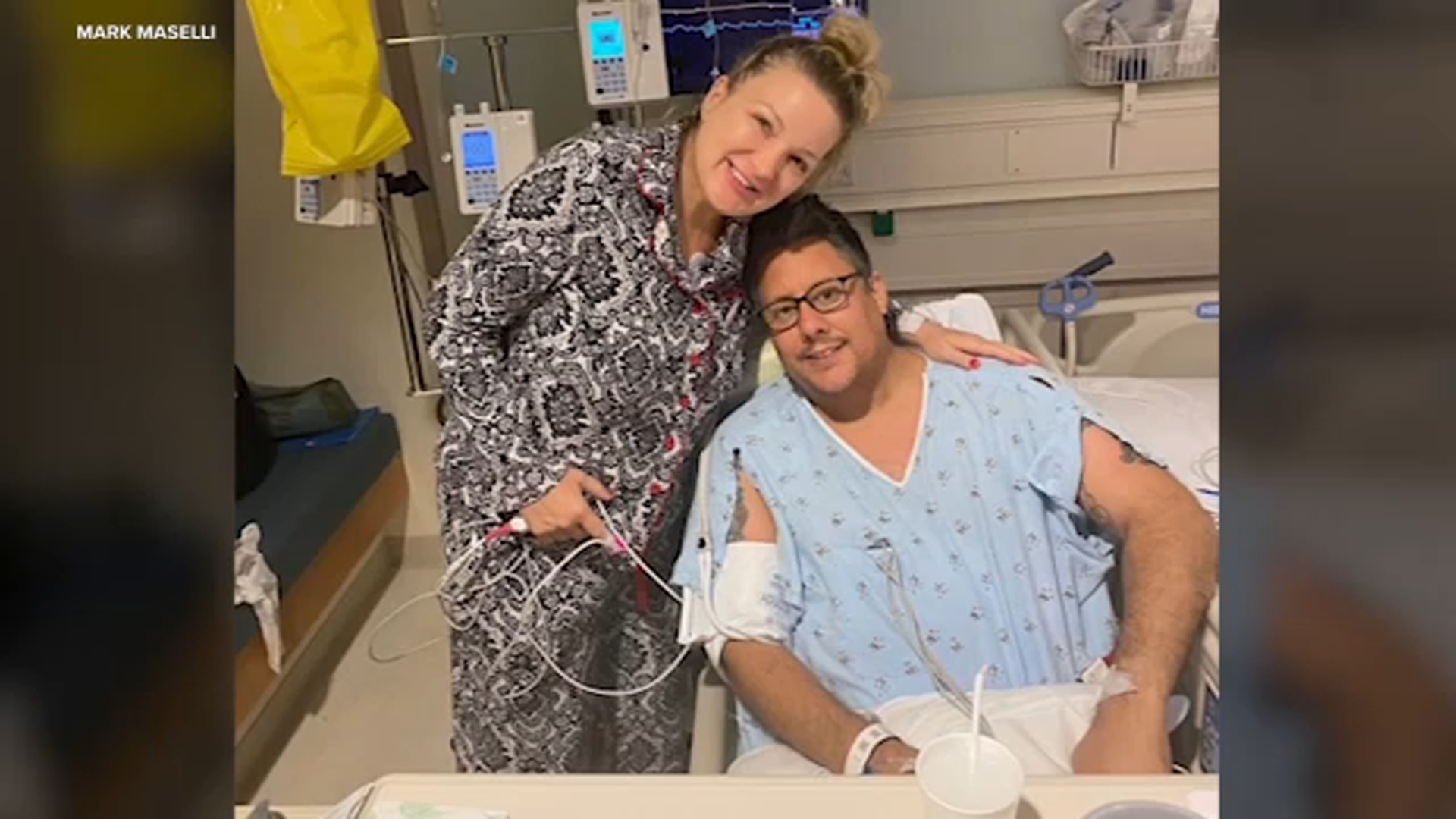
One Lakewood man was able to do just that - and discovered along the way that his donor was a long-lost relative.
A life-changing match
Mark Maselli, 49, grew up watching kidney disease devastate his family. His mother, grandmother and other relatives struggled with polycystic kidney disease, or PKD.
"Two of my uncles passed away before they turned 40," Maselli said.
PKD can lead to fatal complications over time. As Maselli's condition progressed and dialysis loomed, doctors told him a kidney transplant was his best option.
Determined to find a donor, he decided to take an unconventional approach.
"When things started kind of going south, I got proactive and went on Facebook," Maselli said.
One of the people who saw his post was 56-year-old Bonnie Kaiser, who now lives in Florida. At the time, the two had never met.
"When I went in to test for him, I had never even met him," Kaiser said.
Kaiser had been adopted and was searching for her biological father. A DNA test eventually revealed a sibling match, connecting her with a group of biological brothers and sisters.
"Within 30 minutes, I was on a group chat with all 5 of my brothers and sisters," Kaiser said.
Maselli turned out to be her brother-in-law!
After seeing his Facebook post, Kaiser decided to quietly get tested to see if she could be his kidney donor.
"I didn't want to tell them until I knew for sure that I was a match," she said.
The average wait time for a kidney transplant is roughly five years, but in Southern California, it can approach 10 years.
Doctors say that makes living donors especially critical.
"Living kidney transplantation is the best treatment for kidney disease because you can often avoid dialysis altogether or you get a kidney faster than waiting years and years for a deceased donor kidney," said Dr. Uttam Reddy, medical director of kidney transplantation at UCI Health.
Reddy said compatibility begins with matching blood type, along with other factors such as age and size.
"When a person donates their kidney, their other kidney kind of grows in response to that, so they get more kidney function out of the original remaining kidney," Reddy said.
Even though they are not related by blood, Kaiser turned out to be Maselli's best match. She revealed the news at a family gathering by handing him a kidney bean.
"Why would you give me a kidney? As soon as I said the word kidney, I made the connection in my head," Maselli said. "The whole room just burst into tears. It was a really, really sweet moment," Kaiser added.
The transplant took place in 2023. Maselli says he now honors the gift by living fully.
"This guy is running marathons with my kidney," Kaiser said. She says she is inspired to take her remaining kidney and run alongside him.
"You don't have to live the story that you have been told you have to live. You can make choices and you can make changes that can alter your path," Maselli said.
Reddy noted that living donors also benefit from receiving a complete health evaluation, which can sometimes uncover issues that might otherwise go unnoticed.
He added that the National Living Donor Assistance Center can reimburse eligible donors up to $6,000 for travel and other related expenses.