Live

Cause of Boyle Heights warehouse fire believed to be testing conducted by solar contractors: Lineage

ByABC7.com staff KABC logo
Last updated: Wednesday, June 24, 2026 12:49AM GMT
Boyle Heights fire: LA County ratifies emergency declaration

BOYLE HEIGHTS, LOS ANGELES (KABC) -- Crews continue to battle flare-ups of the massive warehouse fire in Boyle Heights days after it ignited, as the region sees significant impacts from the smoke.

The inferno began shortly before 2:30 p.m. Wednesday at Lineage cold storage facility in the 1400 block of South Los Palos Street.

The fire is believed to have started while contractors were conducting testing on a rooftop solar array, Lineage said to Eyewitness News in a statement.

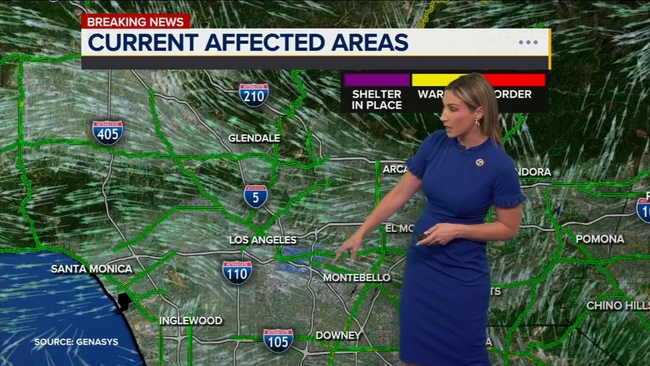
Air quality concerns persist for large swaths of Los Angeles, but the U.S. Environmental Protection Agency and South Coast Air Quality Management District have not detected anything beyond normal combustible material typical after a fire, a Los Angeles Fire Department spokesman said.

Gov. Gavin Newsom declared a state of emergency Saturday for Los Angeles County in response to the ongoing firefight, directing state agencies to support local response efforts and help protect public health and safety. This comes after Mayor Karen Bass issued a local emergency declaration early Saturday afternoon to mobilize additional resources to the city for the days ahead.

The Los Angeles Fire Department described the massive blaze as a "very complex" fire with numerous hazards for firefighters.

No injuries were reported.

City News Service contributed to this report.

Este blog se ofrece en Español, aquí.

KABC logo
Jun 22, 2026, 1:50 AM GMT

LAFD changes tactics as dayslong fire continues to burn

Days after a fire erupted at a warehouse in Boyle Heights, the Los Angeles Fire Department changed its tactics as the stubborn blaze continued to burn.

Speaking to reporters on Sunday, LAFD Chief Jaime Moore said: "I've really got some great news for everybody, we've made some incredible headway since our last press conference" on Saturday afternoon.

"We brought in some -- as I mentioned yesterday -- some water-dropping helicopters that were larger, 3,000 gallons," Moore said. "They were dropping a retardant on it. We did those flights and then we started to go back to our traditional methods -- and that was our use of our ladder pipes."

The ladder pipes deliver between 1,500 and 2,000 gallons of water on the burning surface of the structure.
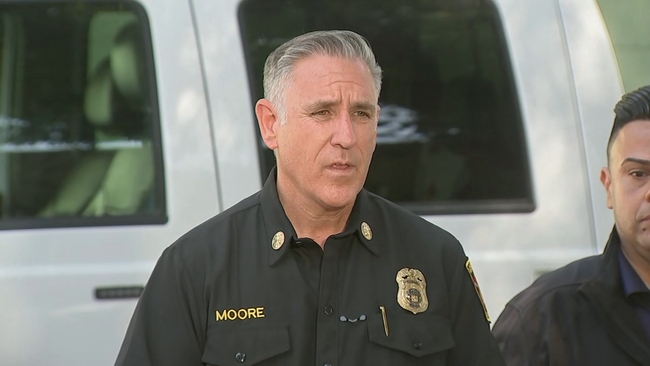
LAFD Chief Jaime Moore explained how the Los Angeles Fire Department is using water cannons in the ongoing firefight at a warehouse in Boyle Heights.

"What we did change was this: We split this building in half and we've been concentrating on saving what we call Cooler 1," the fire chief said, noting that that dimensions of the massive structure are 1,000 feet by 500 feet. "Cooler 1 has not had any fire impinge in it, so it hasn't been fully involved, so we've been able to keep that cool and isolated."

Meanwhile, firefighters with excavators have now gone into the part of the building known as Cooler 2, where the main fire burned, and the LAFD's heavy-equipment operators have torn off the well-insulated walls.

The walls "have corrugated steel on the outside, we have corrugated steel on the inside, and inside is the foam," Moore explained.

KABC logo
Jun 22, 2026, 12:48 AM GMT

Could the Boyle Heights fire lead to a food shortage at SoCal supermarkets?

At a news conference on Sunday afternoon, LAFD Chief Jaime Moore was asked if the ongoing fire at the massive cold-storage facility in Boyle Heights could lead to a food shortage at grocery stores and restaurants in Southern California.

Moore had previously said that 85 millions tons of food were inside the warehouse, most or all of which was expected to spoil due to the disastrous fire.

"They told me that there were about 70 semitrucks per day that pulled frozen food out of this facility," he said. "I'm not an expert in food and I'm definitely not an expert in the distribution of food, so I can't really speak to that. But I don't think we've seen an impact just yet."

At a news conference, LAFD Jaime Moore was asked if an ongoing fire at a massive cold-storage facility in Boyle Heights could lead to a food shortage at grocery stores and restaurants in Southern California.

Moore noted that Los Angeles is currently serving as one of the World Cup host cities, "and I don't think any of our bars, restaurants or supermarkets are running out of food just yet."

Carley Gomez Image
Jun 21, 2026, 3:23 PM GMT

Live far from fire? You may still smell smoke

Smoke from the fire drifted across Southern California on Sunday, darkening skies and prompting concerns about worsening air quality in several regions.

Smoke from the fire drifted across Southern California on Sunday, darkening skies and prompting concerns about worsening air quality in several regions.

A live camera view from Los Angeles International Airport facing SoFi Stadium showed a growing plume of smoke spreading across the area throughout the morning.

Shifting wind patterns played a major role in moving the smoke into heavily populated area, including areas in the San Fernando Valley.

Footage from Burbank showed hazy skies, with smoke mixing with cloud cover, which could trap pollutants closer to the ground.

As of Sunday morning, winds were pushing smoke westward from the Boyle Heights area before shifting north, spreading poor air quality conditions into nearby communities.

The worst conditions were initially reported overnight in the San Bernardino and Ontario areas, where smoke settled in valleys. By Sunday morning, conditions had worsened farther north, including the Hollywood Hills, Sherman Oaks and Studio City.

Areas just north of the fire were experiencing the most significant air quality impacts.

An air quality alert remains in effect through at least midday Sunday and could be extended until the fire is fully contained.

KABC logo
Jun 21, 2026, 6:06 AM GMT

Heavy-lift helicopters, firefighting robot aid battle at cold storage facility

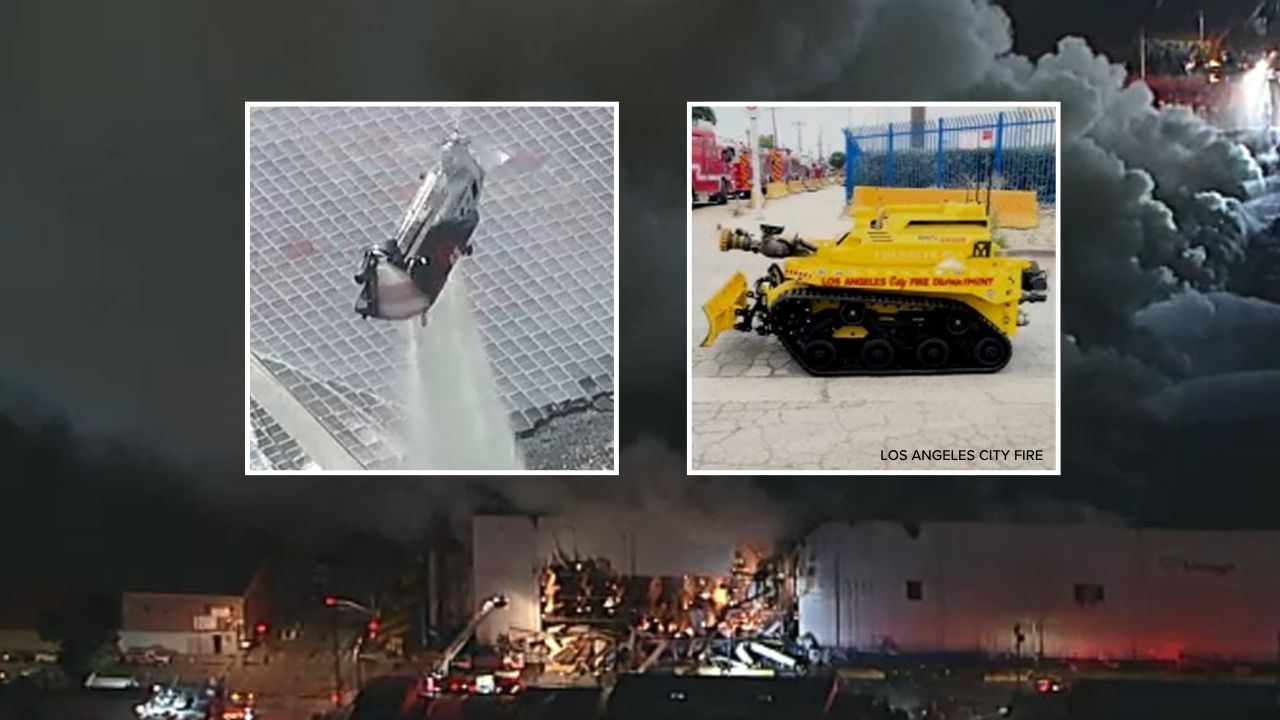
A major firefighting effort continued at a cold storage facility as authorities deployed heavy-lift helicopters capable of dropping thousands of gallons of water and a structural firefighting robot to combat flames and suppress dangerous flare-ups.

Officials said the county brought in CH-47 Chinook helicopters, which can drop up to 3,000 gallons of water at a time. Earlier in the response, the city relied on smaller helicopters that delivered only a fraction of that volume. Authorities also said the county aircraft can deploy a fire-suppressing gel, expected to help extinguish flames still burning on the top and roof of the building.

Aerial drops were halted overnight, but ground crews continued working to contain the fire amid concerns about structural instability. Authorities said crews remained on scene at the facility, maintaining water flow as conditions evolved.

The Los Angeles Fire Department said ground teams were using a structural firefighting robot to help suppress flare-ups in areas that may be too dangerous for personnel.

"Firefighter safety remains the top priority, as crews have identified areas of wall instability due to the significant volume of water being applied to the structure," the department said.

LAFD Chief Jaime Moore called the fire "very unique" and said crews were using water-dropping helicopters for a structure fire - which are more commonly used for brush fires - but the size of the warehouse necessitated the aerial operation.

Moore said he has been with the department 31 years and this was only the second time he could recall aerial water drops being used to battle a structure fire. The previous incident occurred about six years ago in Echo Park.

"These are unprecedented tactics that are being used," Moore said. "And so when people are asking, what is our fire department doing? To be very aggressive and improve the situations. This is an example of this."

Officials said aerial suppression operations concluded for the evening, but ground crews would remain actively engaged overnight using large volumes of water and specialized equipment, including the firefighting robot.

Authorities added that smoke conditions are expected to change as weather patterns shift and suppression efforts continue, while crews monitor the building for further instability.

City News Service contributed to this report.