2026 NFL offseason: Ranking 10 biggest position upgrades

It's the end of May. NFL free agency is done. Trades are mostly done (looking at you, A.J. Brown). The draft is done. Even the second wave of postdraft free agency is wrapping up, with players like Jauan Jennings andDante Fowler Jr.committing to teams. Save for the supplemental draft in late June (which might end up mattering this year withBrendan Sorsby), all of the big offseason events for player acquisition are complete.
With the dust settled, I listed the 10 positional groups I think improved the most from the end of 2025 to kickoff of the 2026 season, specific to teams. Plenty of groups that made big acquisitions failed to make the cut, as their standard of play from last season was too high to begin with. For instance, Alex Anzalone and Josiah Trotter make a great new linebacker duo in Tampa Bay, and I admire how well the Buccaneers filled that hole. But they had such a great need only because they lost Lavonte David to retirement, and he was a great player right until the end.
I'm focusing more on the biggest net gains from last season to now, not just the best additions. As such, here are my 10 groups that have taken the biggest leap over the past few months -- and what we can expect from them moving forward.
Jump to a position improvement for:
ARI | CIN | CLE | LV | LAC
LAR | NYG | TEN | WSH


1. Arizona Cardinals running backs
In: Jeremiyah Love, Tyler Allgeier
Out: Michael Carter, Emari Demercado
Five running backs had at least 40 touches for the Cardinals last season, which is too many running backs. Injuries to James Conner and Trey Benson forced Arizona into a three-man rotation with Carter, Bam Knight and Demercado. Carter and Knight were the early-down ball carriers, while Demercado was the third-down scatback.
Carter and Knight were also two of the six worst rushers by yards over expectation last season, per NFL Next Gen Stats. Carter averaged 0.8 fewer yards than expected per rush; Knight was just above him at 0.7. Demercado, hilariously, was the league leader in rushing yards over expectation per carry at 2.5, thanks in large part to a few explosive third-down draws. Of course, one of those ended with a self-inflicted fumble at the 1-yard line, such that Demercado ended up with one of the worst EPA per carry numbers of the season.
The returns of Conner and Benson from injury will help this group out some. But Benson has failed to move the needle in his first two years as a pro and has endured two leg injuries in two years. Conner, who joined the Cardinals with an injury reputation but has been generally healthy, suffered a gnarly foot/ankle injury in 2025 and returned to the Cardinals only on an adjusted contract. (He was a cut candidate otherwise.)
In need of a more trustworthy primary ball carrier, the Cardinals signed Allgeier in free agency from the Falcons. A bruiser between the tackles, Allgeier was a 1,000-yard rusher before the Falcons drafted Bijan Robinson in 2023, at which point he became a thunderous change-of-pace back. For a moment, it looked like he might reclaim the lion's share of the carries with the Cardinals ... until they drafted Love with the third pick.
At this point, the Love and Allgeier combo makes the Cardinals' RB room one of the league's most improved positional groups, hence the No. 1 ranking here. Love has the lightning-quick speed and tackle-breaking ability to pair nicely with Allgeier's gristly style, and he catches the passes on third down that Allgeier doesn't want to see. Of course, any selection of a back with the No. 3 pick predicts a dominant share of touches, and Allgeier was signed for only $6 million per year, so an even workload split is far from guaranteed.
With the drafting of Love, Allgeier becomes an interesting trade candidate. Even in this young NFL offseason, there are teams with fluctuating running backs rooms. Packers RB Josh Jacobs was arrested this week, then released amid an ongoing investigation into domestic violence charges; his status for the 2026 season is in question. Buccaneers RB Bucky Irving is out for the summer and potentially into the fall with lingering shoulder issues. And the Jaguars' RB room, featuring Bhayshul Tuten and Chris Rodriguez Jr., is still mighty thin. If the Cardinals want to trade Allgeier, despite signing him to a multiyear free agent contract just months ago, they should have suitors.

2. Las Vegas Raiders linebackers
In: Quay Walker, Nakobe Dean
Out: Devin White, Elandon Roberts, Jamal Adams
It's a total overhaul in Las Vegas, as not one of the four linebackers to get over 200 snaps last season returns to play for the Raiders. (Germaine Pratt, the fourth,was cut during the season.)
Not only are all four no longer Raiders, but none of the four has signed with another team so far. White, who had a Raiders-record 174 tackles last season, still has some utility as a run-stopping linebacker with the size and speed to see the field in sub packages. Similarly, Roberts is a physical run defender who deserves a roster spot somewhere. But neither should have been an every-down starter last year -- especially beside one another, given the redundant skill sets. There was a lot wrong with the Las Vegas franchise last season, but even with a good coaching staff and healthy secondary, this linebackers room was a nonstarter.
GM John Spytek overhauled the group with a pair of old teammates: Walker and Dean played beside one another as Georgia Bulldogs in 2020 and 2021 before parting ways in the 2022 draft. Dean and Walker are a complementary duo. Dean might be undersized, but he has many traits of a prototypical signal-calling Mike linebacker: great recognition and instincts, plus physical tackling skills.
With Dean calling the plays, Walker will be freed to play more run-and-chase roles, which suits his size and speed strengths. Walker's experience wearing the green dot in Green Bay insures the Raiders against a potential long-term Dean injury, as availability has been an issue at times for Dean. He missed time with a foot injury in 2023 and a knee injury (suffered in the 2024 playoffs) in 2025.
The Raiders anticipate moving to a 3-4 front structure under new defensive coordinator Rob Leonard, and reading between the lines of their offseason moves, I expect them to play with extra DBs on the field as much as possible. Second-round rookie safety Treydan Stukes and incumbent safety Jeremy Chinn are both great box players, and it's unlikely the LB3 on this roster gets many snaps. Leonard is a Mike Macdonald-inspired coach, and those defenses have needed a dynamic playmaker at linebacker (Roquan Smith,Ernest Jones IV) to fit the run from light boxes. In Dean and Walker, the Raiders have two solid options.

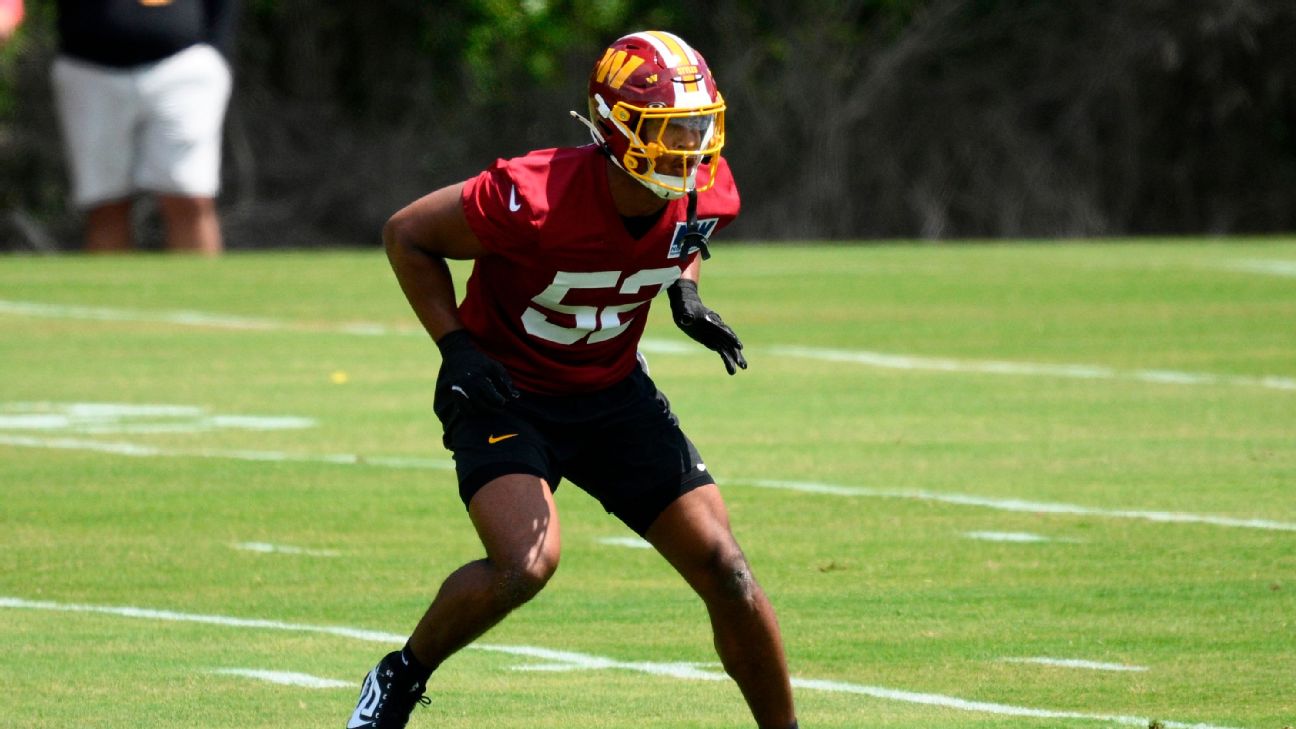
3. Washington Commanders linebackers
In: Leo Chenal, Sonny Styles
Out: Bobby Wagner
One of the more brutal declines of the past few years has come from Wagner. As smart as they come, Wagner has continued racking up tackle numbers even in the twilight of his career, with 162 last season and a career-best 183 in 2023 with the Seahawks. He was making All-Pro teams as recently as 2024 for his incredible durability and nose for the ball carrier.
But Wagner's lack of speed was a glaring weakness for the Commanders' defense over the past two seasons. In 2025, Wagner's max speed topped out at 18.2 mph, according to Next Gen Stats' tracking data -- fifth slowest among starting off-ball linebackers. His average speed -- 9.1 mph -- was dead last. The difference between Wagner and second worst (Cody Simon) was as large as the difference between Simon and 14th worst.
Wagner lacked explosiveness and change of direction along with true top-line speed, and as such, he could not get where he needed to be in coverage. He allowed a 109.4 passer rating when targeted, 12th among all linebackers. The 444 yards after the catch he gave up was the most of any linebacker in the league.
In free agency, the Commanders let Wagner hit the open market and signed Chenal from the Chiefs as a potential replacement. Chenal is younger and faster than Wagner, and in new defensive coordinator Daronte Jones' system, he will be used as a rusher from on- and off-ball alignments. But Chenal was a rotational player in Kansas City who didn't spend much time in coverage, and his role in the new defense could be redundant with incumbent Frankie Luvu's ideal job. More was needed.
The stars aligned in the draft when Ohio State LB Styles fell to Washington at No. 7. Styles is a converted safety who brings the coverage chops sorely lacking in Washington's linebackers room. At his size (6-foot-5 with an 81-inch wingspan) and with his speed (4.46-second 40-yard dash), he occupies a ton more space in zone coverage than the average LB. Styles hasn't taken a snap of NFL football yet, so I don't want to get over my skis here, but this is a player with revolutionary potential.
Washington's linebackers were a mark for opposing offenses last season. This year, they should be a far faster and more versatile group -- one that forces offensive attention elsewhere.

4. Tennessee Titans wide receivers
In: Carnell Tate, Wan'Dale Robinson
Out: Van Jefferson
When your top-pick rookie quarterback ends up heavily targeting two Day 3 rookie receivers, your WR room needs some help. Elic Ayomanor, a fourth-rounder, paced the Titans last season with 89 targets; fellow fourth-rounder and special teams ace Chimere Dike had 74 targets, just behind tight end Chig Okonkwo (79).
Both Ayomanor and Dike showed valuable flashes as playmakers, but neither did enough to emphatically secure a full-time role in the offense. Ayomanor struggled with drops -- his catch rate of 44.4% was 12.7% below expectation by Next Gen Stats' model, fifth worst among all receivers. Dike was a wonderful returner with great speed but couldn't connect with Cam Ward on deep patterns and struggled to break tackles on underneath routes. Both Dike and Ayomanor ended the season averaging 1.0 yards per route run: 211th and 212th, respectively, among 238 high-volume receivers.
The Titans could not reasonably anticipate development from Ward, who was plenty flashy as a rookie, with this room as it was. In free agency, the Titans snagged Robinson, who was a handy slot maven for offensive coordinator Brian Daboll when he was the head coach of the Giants. Robinson spent a little more time out wide last season and got targeted deeper accordingly. He had 17 deep targets after 10 total in the previous two seasons. His blossoming was largely the result of Malik Nabers' seasonlong absence but is still only good news for the Titans, as Robinson can be a three-level option if need be.
Hopefully he will remain more of a slot player with high-volume underneath games, as Tate joins as the traditional WR1 with huge downfield potential. While Tate looks the part of that traditional WR1, he does lack the bona fides; during his time with Ohio State, he was the WR2 toJeremiah Smith. Yet that role gave him downfield opportunities on shot plays, where his ball tracking and catch radius shined. Tate is capable of playing the field-stretching Robin to Robinson's Batman, should the Titans end up distributing targets on a game-by-game basis between their two new receivers.
There were no major losses in the Titans' receivers room. Jefferson had 52 targets on 583 snaps, but his advanced numbers were worse than those of Ayomanor and Dike. If a healthy Calvin Ridley offers any meaningful contributions, this is suddenly a fairly deep room with a few good bets on a reliable, dangerous wide receiver emerging for Ward.

5. Cleveland Browns offensive line
In: Spencer Fano, Tytus Howard, Elgton Jenkins, Zion Johnson, Austin Barber
Out: Joel Bitonio, Jack Conklin, Ethan Pocic, Cam Robinson, Wyatt Teller
No unit in the league was more emphatically overhauled than Cleveland's offensive line. Five of the six leading snap-getters from last season are no longer with the team, and three of them (Bitonio, Teller and Pocic) were multiyear starters. It's tough to measure just how poorly that interior trio played, as the carousel at both tackle spots hamstrung the entire unit. But the Browns were 31st in adjusted line yards (according to FTN Fantasy), 20th in pass block win rate, 24th in run block win rate and 32nd in quick pressure rate surrendered. It was comfortably a poor unit.
Out with the old, in with the new. The Browns could potentially field a starting offensive line made entirely of players they've acquired in the 2026 league year. Howard, acquired from the Texansvia trade, figures to start at right tackle. First-round pick Fano will man the left side. Jenkins, cut by the Packers, has played better at guard than at center in his career, but with the big free agent signing of Johnson, Jenkins looks like he'll stick at center with Cleveland. The other guard spot comes down to incumbent Teven Jenkins and Barber, a third-round rookie who played tackle in college but is likely to convert to guard in the league.
There isn't one individual move here that blows me away as a clear upgrade. We've seen worryingly poor play from Jenkins, Howard and Johnson in recent stretches -- that's why they were available. But collectively, the infusion of new blood makes it likelier the Browns hit big on at least one acquisition. Say Fano is a lights-out rookie tackle, or Johnson sees the light bulb turn on in a new ZIP code. Just two plus starters would move the needle considerably from last season to this season.
There's a lot of jelling to do in the new group -- and just one injury could reshuffle the whole deck. But given how poor the Browns' line was last season, an average group in 2026 would easily qualify for the most improved positional groups.

6. Los Angeles Rams cornerbacks
In: Trent McDuffie, Jaylen Watson
Out: Cobie Durant, Darious Williams
You knew they'd be here.The Rams traded a first-round pick (and then some!) for McDuffie, then snagged his teammate Watson in free agency not a week later, rebuilding the cornerbacks room that was their Achilles' heel during last season's run through the NFC playoffs.
Top Stories

This is a tricky one because the Rams' cornerback play wasn't bad in a vacuum. In fact, over the past two seasons combined, Durant's numbers were some of the best among league corners: 6.4 yards per target ranks 13th, behind mostly big names like Quinyon Mitchell, Pat Surtain II, Derek Stingley Jr., Christian Gonzalez and ... McDuffie.
But Durant did need to have a defense structured to make his play style work. Defensive coordinator Chris Shula ran a ton of zone and rarely asked his corners to align up at the line of scrimmage. That protected Durant, who lacks great speed or size, from chasing receivers all across the field. Durant allowed very little yardage but also forced few tight-window throws (17.9% of targets, well below the league average of 24.1%). That's why players like Emmanuel Forbes Jr. and Ahkello Witherspoon have gotten run for the Rams in recent years -- Shula was looking for a press-man option. Durant was pressed on 18% of his snaps last season, while Forbes was 26.3% and Witherspoon was 33.5%.
As such, the story of the Rams' cornerback improvement starts not with McDuffie but with Watson. A suffocating presence at the line at 6-2 with over 32-inch arms, Watson is at his best winning the physicality battle in the first 5 yards. He isn't a perfect player (see: George Pickens film in 2025), but he's multiple tiers better than Forbes and Witherspoon. He will give Shula the tools he needs to play more man coverage, as will McDuffie, who is a wonderful press technician despite below-average 5-11 size.
The Rams will major in zone coverages and big cushions, and Watson can still play in those (and McDuffie will thrive in them). But Shula can be much more versatile in how he picks his matchups now that he has the pair of new cover men. Watson can handle the traditional "X" receivers who tend to give McDuffie issues (think Mike Evans), while McDuffie can travel inside and outside with versatile receivers (think Jaxon Smith-Njigba). Both can still zone off, and their pre-snap alignments won't reveal Shula's post-snap intentions. On both talent and scheme, this is a big leap.

7. Cincinnati Bengals defensive line
In: Boye Mafe, Dexter Lawrence II, Jonathan Allen, Cashius Howell
Out: Trey Hendrickson, Joseph Ossai
The 2025 Bengals were dead last in pass rush win rate (28.8%). Getting only seven games from Hendrickson contributed to that performance, of course -- but even then, Hendrickson was not his typically dominant self on passing downs. First-rounder Shemar Stewart looked even rawer than anticipated, and the much-needed ascension of Kris Jenkins Jr. or free agent signing T.J. Slaton Jr. on the interior simply did not occur.
The pass-rushing performance is worrisome, but the Bengals couldn't even get opposing offenses behind the sticks and let their pass rush out of the gate. Cincinnati had a defensive stuff rate -- that's rushes of zero or negative yardage -- of 10.2% by Next Gen Stats' numbers. No defense has stuffed runs at a worse pace in the past five years.
Enter Lawrence. Though the Giants' rushing defense had numbers as poor as the Bengals' in some cases, it actually got stuffs at a pace above league average. Lawrence (when healthy) is one of the few defensive tackles in the league who can anchor in space without losing ground and also create tackles behind the line of scrimmage with first-step penetration. The steep price the Bengals paid for Lawrence's services -- the 10th overall pick -- is a testament to how badly they needed his presence on the interior.
Both of last year's starters (B.J. Hill and Slaton) return as rotational players alongside Lawrence and Allen, who is beyond his best ball but can still create splashes in limited snaps. Cincinnati should be much stronger in the core of its defense this season. And in Mafe, the Bengals have added a defensive end with the size and toughness to create further stops in the running game. They should actually get to third-and-longs this season.
Here, they might feel Hendrickson's absence. But the addition of Howell in the draft gives them a speed rushing presence that pairs nicely with Mafe, Myles Murphy and Stewart (from whom they need a step forward in Year 2). This is a much deeper and more balanced unit than it was last season.

8. New York Giants linebackers
In: Arvell Reese, Tremaine Edmunds
Out: Bobby Okereke
Earlier, I highlighted an NFC East team with a slow-footed veteran linebacker in need of an athletic spark. I could copy-and-paste much of that analysis here and call it a day.
The Commanders shed Bobby Wagner in favor of Leo Chenal and Sonny Styles. The Giants, meanwhile, are moving on from Okereke, whomthey released before the final year of his deal. Okereke, like Wagner, simply struggled to move last season. His average speed of 9.8 mph was 13th slowest among off-ball linebackers. He had better chops in coverage but had issues securing tackles. After Okereke's running mate Micah McFadden went down with a Week 1 injury, a rotation of alternatives (Darius Muasau, Demetrius Flannigan-Fowles, Zaire Barnes) did little to elevate the group.
The Giants swapped Okereke for Edmunds, who himself was a cap casualty in Chicago. Edmunds was drafted a year before Okereke but is younger, bigger and faster -- he just has a larger range of influence, even if he still has mental lapses on the field. Had Edmunds been the only change, the Giants' linebackers room wouldn't have sniffed this list.
But he's not. New York also adds Reese with the fifth pick, and that is exciting. Reese was discussed as an edge rusher for much of the predraft process, but I've always liked him best as an off-ball linebacker. He's a particularly cool fit beside Edmunds, as both have a blend of speed, length and size not often found at off-ball linebacker. The Giants' linebackers room certainly wins the title of "first off the bus."
Though Reese was considered a bit of a developmental edge rusher, he's a ready-made NFL linebacker. He has quality technique for taking on blocks, and though he'll always be more dangerous as a blitzer than as a dropper, he's not lost in coverage, either. Reese and Edmunds should give the Giants an infusion of team speed and stopping power at the second level of the defense. And New York's 2.5 yards allowed before contact per carry last season -- the league's worst figure -- should recover back to league average.

9. Los Angeles Chargers tight ends
In: David Njoku, Charlie Kolar
Out: Tucker Fisk, Will Dissly, Tyler Conklin
Two things are simultaneously true. The first:Oronde Gadsdenwas a nice find by Chargers GM Joe Hortiz in the fifth round of the 2025 draft, and he settled into a quality role as a downfield play-action target in the Chargers' offense. The second: If a fifth-round rookie tight end was a breakout star by Week 6, your tight ends room simply was not very good.
The Chargers envisioned a big, bruising rotation of tight ends under offensive coordinator Greg Roman. Dissly and Conklin were the Week 1 starters, with Fisk and two-way player Scott Matlock joining as FB/TE move pieces. A knee injury knocked Dissly out of the lineup for Weeks 3-5, but the total blocking performance of the group was unremarkable overall. Dissly has nominal receiving value and struggled in the trenches. Conklin, who was supposed to be the receiving option, had 50 of his 101 receiving yards in Week 1 and then fell off the map. The Chargers didn't even have rotational pieces to build a tight end in the aggregate, save for Gadsden.
The first issue to solve was finding a high-impact blocker to pair with Gadsden. Hortiz called upon an old Baltimore friend in Kolar. Cut from the Dissly cloth (but much younger and still in his prime), Kolar is a legitimate needle mover against defensive ends in the running game. He's one of a few tight ends in the league who can be trusted to hold his water in one-on-one pass-blocking responsibilities on edge rushers, too. New offensive coordinator Mike McDaniel, off the Shanahan tree, will feature a player like Kolar as a lead blocker on the move in his diverse running game.
But the Chargers didn't stop there. The one-year deal they tossed to Njoku postdraft is one of the more exciting team-player pairings of free agency. Yes, Njoku will turn 30 in July and has a deep injury history, with multiple knee injuries in the past two seasons, so the risk is high. But the Chargers guaranteed him only $850,000 and put the bulk of his money in performance incentives, and a healthy Njoku will perform in this offense. Njoku has excellent hands in contested situations and should slide nicely into the red zone role McDaniel used Darren Waller in last season with the Dolphins. Njoku has also improved as a blocker over his time as a pro, and McDaniel will use him as a blocker out of the slot or in space if Gadsden is not yet ready for those asks.
With Alec Ingold entrenched as a bona fide fullback, the Chargers will actually get production out of personnel diversity this season. The depth of their tight ends room is a big reason why.
10. Washington Commanders edge rushers
In: Odafe Oweh, K'Lavon Chaisson, Charles Omenihu, Joshua Josephs
Out: Jacob Martin, Von Miller, Preston Smith, Jalyn Holmes
The Commanders' leading snap-getter at edge rusher last season was Martin. At 30 years old and on his seventh team, Martin played 670 snaps -- tied for his career high and more than triple the amount he had in any of the previous four seasons.
This was not the plan, of course. The Commanders wanted to start Deatrich Wise Jr. and Dorance Armstrong, but Wise was placed on injured reserve before Week 3 and Armstrong joined him before Week 8. Martin became an early-down player alongside another veteran journeyman (Smith), with Miller and Holmes in rotational support. Smith and Miller were both well over 30 already, while Holmes turned 30 in January.
Unsurprisingly, this was not a great rotation. Armstrong was great to start the season, but in his absence, Miller became the Commanders' best pass rusher with an 11.8% pressure rate -- below the season average for starting edge rushers. On the year, the Commanders' four-man rush had a pressure rate of 30.5%, 23rd in the league.
Armstrong is on his way back, but it's never good when a 29-year-old coming off a torn ACL is a load-bearing part of your pass rush. Washington poured money into the position. It signed Oweh to a deal worth $25 million per year when the legal negotiating window opened and chased that signing with a one-year, $12 million deal for Chaisson. Both of them are speed rushers with recent production spikes; Chaisson's tally of 7.5 sacks last season for the Patriots was a career best, and Oweh's 7.5 sacks with the Chargers were accumulated in only 12 games.
Oweh and Chaisson are a little lacking in size and staunchness, so the Commanders also added Omenihu, another familiar face to general manager Adam Peters. (He played for the 49ers in 2021 and 2022, when Peters was still in San Francisco.) Omenihu, like Wise, is a player with end/tackle versatility. New defensive coordinator Daronte Jones will benefit from this deep room on late downs, when he wants to flood the defensive line with bodies for every gap, a la Brian Flores in Minnesota.
The Commanders still don't have a true ringer of a defensive end -- Oweh was a rotational player with the Chargers even as he was breaking out. But they have a deep group with different body types and much more juice than last season. Good work.
Just missed
Las Vegas Raidersquarterbacks: There isn't much analysis to give here. Kirk Cousins and Geno Smith are fairly similar QBs at this stage in their respective careers. But add in the enormous boost of first pick Fernando Mendozaand the Raiders' QB room is much stronger than it was last season.

San Francisco 49ers wide receivers: The 49ers lose Jauan Jennings and Kendrick Bourne but replace them with Mike Evans and Christian Kirk. On the veteran market, that's an upgrade. Evans in particular brings an element of size and catch radius the 49ers haven't had under coach Kyle Shanahan. Throw in De'Zhaun Stribling -- a talented rookie, if perhaps a tad overdrafted -- and the 49ers have a deeper receivers room this year.

Houston Texans offensive line: The Texans added Braden Smith, Wyatt Teller and Keylan Rutledge this offseason, completing an offensive line overhaul that began last year with guys like Ed Ingram and Aireontae Ersery. If this were a "most improved over two years" list, they'd be an easy inclusion. I have high expectations for this group overall.

Kansas City Chiefs running backs: The Chiefs have had a historically unexplosive running backs room in the past two seasons, as neither Isiah Pacheco nor Kareem Hunt runs away from pursuit when he gets into open space. Enter Kenneth Walker III, who has always been a jitterbug playmaker and came into his own with more down-to-down consistency in Seattle's postseason run. It's an obvious and much-needed upgrade.

New York Jets defensive line: The Jets' total tonnage of additions in the defensive trenches is hard to argue with: Joseph Ossai, Kingsley Enagbare, David Bailey, T'Vondre Sweat and David Onyemata. Of course, they lost Jermaine Johnsonin a trade this past spring, and Quinnen Williams was made a Cowboy at last year'strade deadline. It's certainly a deeper group, but I'm not sure there's a clear plus starter anywhere (besides 2025 breakout Jowon Briggs, one of the league's best-kept secrets).
]