2026 Stanley Cup playoffs: Lessons learned, what comes next

The 2026 Stanley Cup playoffs began nearly a month ago. Six teams remain in the tournament, and 10 teams have been cast into the abyss.
There are lessons to be learned from this intense, remarkable postseason, about teams and players and what we expect from the NHL. Here are six hard lessons from the Stanley Cup playoffs:

Lesson: We underestimated the impact of the condensed schedule
Dallas Stars general manager Jim Nill has worked in NHL front offices since 1991. He has rarely experienced a season this exhausting.
"In all my years in hockey, this was probably one of the most demanding regular seasons I've ever gone through," he said. "That's the whole league. It's not only us but the whole league with the scheduling travel and the injuries."
The NHL's return to the Winter Olympics meant compressing the 2025-26 schedule to compensate for the multiweek break in February. That was coming off a compressed schedule at the start of last season to compensate for the 4 Nations Face-Off.
"We have to have a compressed schedule," NHL commissioner Gary Bettman told the New York Post. "We have to take into account that NHL teams send various amounts of players to the Olympics. Teams like Tampa and the Panthers send 10 players each, and we've got some teams sending one or two players. Teams are going to come back in a different place in terms of how they are than when we left. The fact of the matter is some teams are going to have a good chunk of their roster a little more tired and banged up."
According to NHL Injury Viz, which tracks roster absences, there were 8,160 man games lost to injury this season in the NHL. At the high end was Florida with 540 games, which included the 82 games Aleksander Barkov missed and Matthew Tkachuk being limited to 31 games. The Panthers missed the playoffs. Then again, so did the Detroit Red Wings, who had an absurdly low 86 games lost to injury, the fewest in the league.
There was also an injury cost for players going to the Olympics. After Boston's Charlie McAvoy and Florida's Matthew Tkachuk were injured at 4 Nations, the Winter Games resulted in the Los Angeles Kings losing Kevin Fiala for the rest of the season and the Stars' Mikko Rantanen tearing an MCL, which might help explain why he had just one even-strength point in six games this postseason. The Kings and the Stars were one-and-done in the playoffs.
For many teams this season, the question was when the true crunch of the condensed schedule was going to hit.
"When did it happen to you? Early? Some teams got crushed by the schedule in the middle of the season. Other teams got clobbered by it when they were pushing for the playoffs," one NHL general manager said.
Case in point: the Columbus Blue Jackets. They rolled into the Olympic break as the NHL's hottest team, going 10-1-0 after Rick Bowness was hired to replace coach Dean Evason. They were four points out of a playoff spot.
The Jackets would end up missing the playoffs thanks to a late-season spiral that saw them go 2-8-1 in their last 11 games. Bowness infamously torched his players after a loss in their season finale: "These guys, they don't care. Losing is not important enough to them. It doesn't bother them."
Another theory: Maybe they were just exhausted because they got crushed at the wrong time.
Columbus played 17 games in March, the most of any NHL team in a single month this season. That included three back-to-back games and only one break of more than one calendar day.
"It was a grueling schedule," Columbus GM Don Waddell said. "We barely could practice in March because we were playing so many games."
From March 26 through the end of the season, they won twice.
Bowness questioned the mentality of his players towardthe end of the season. Frankly, that's the most underreported aspect of the condensed schedule.
"Some players had really big struggles with mental health or anxiety just because they could never get a breath," an NHL general manager said.
One veteran NHL player told ESPN the condensed schedule impacted how players recovered from adversity.
"If you have a bad game, and then you have another bad game right away, you're playing so many games in a short period of time that it snowballs," he said. "The coach is on you because he's feeling the pressure on him. There were so many more meetings and not as many days off. There weren't as many opportunities to get away from the game.
"I'm sure for a lot of the young guys that haven't been around a long time and haven't been used to that, it was just different."
Next season, the NHL will expand the regular season to 84 games, but without a prolonged break for an international competition.
"The year it was what it is," Waddell said. "Now we move on."
Lesson: Mikko Rantanen begat two juggernauts
Speaking of Rantanen, the aftershocks from last season's two trades involving the star winger are still being felt a year later. And not just because the three teams he played for in 2024-25 -- the Colorado Avalanche, Carolina Hurricanes and Stars -- were the top three teams of this regular season.
The Avalanche traded Rantanen to the Hurricanes in "a tough business decision," according to general manager Chris MacFarland at the time.
After a subsequent trade, Rantanen ended up signing a deal with Dallas that carried a $12 million annual salary cap hit. Colorado quietly hoped that Martin Necas, acquired from Carolina, could provide a decent percentage of the offense Rantanen had given them at a fraction of the cost ($6.5 million average annual value). They also acquired Jack Drury in the deal, a player they liked for their bottom six.
Colorado used a second-round pick acquired in that trade to get center Charlie Coyle from the Boston Bruins. They used Coyle as an enticement to get Miles Wood offloaded from their cap, sending the pair to the Blue Jackets before the 2025 draft.
The cap space the Rantanen trade and related moves created helped MacFarland trade for center Brock Nelson last season, signing him to a team-friendly ($7.5 million AAV) extension. It allowed the GM to continue to tinker, adding defenseman Brett Kulak, center Nicolas Roy and -- most significantly -- Nazem Kadri in a much-anticipated reunion.
The Avalanche have the best center depth in the NHL, in direct contrast with the Minnesota Wild, whose lineup is a doughnut. The four centers behind Colorado'sNathan MacKinnon -- Roy has played the wing, while Drury has centered their fourth line -- came from Rantanen-related moves. Necas has nine points in eight playoff games, after 38 goals and 100 points in the regular season. Necas signed an eight-year extension at $11.5 million against the cap that starts next season.
Then there are the Hurricanes. They acquired Taylor Hall from the Chicago Blackhawks, who picked up part of Rantanen's salary. They picked up center Logan Stankoven from the Stars when they flipped Rantanen there. Those two have partnered with winger Jackson Blake to form the best line still in the Stanley Cup playoffs, earning 68% of the expected goals when on ice together. Hall in particular looks like a coup: The rejuvenated winger leads the team in scoring with 12 points in eight playoff games.
Carolina used a 2026 conditional first-round pick from Dallas to help acquire defenseman K'Andre Miller from the New York Rangers. Miller has six points in eight playoff games, skating to a plus-9 while being second on the team in average ice time in the playoffs (23:44 per game).
Meanwhile, after not signing Rantanen to an extension, the Hurricanes reallocated the money. Miller got a new contract with a $7.5 million AAV, and the Hurricanes won the competition for free agent winger Nikolaj Ehlers, signing him to a deal with an $8.5 million AAV. Ehlers has four points in seven playoff games, the offensive force on a very solid checking line.
The Avalanche (+150) and Hurricanes (+155) are the heavy favorites to win the Stanley Cup, via DraftKings Sportsbook odds. How they both leveraged losing Rantanen from their rosters is a big reason.
Lesson: It's a tough year for playoff format change supporters
The NHL adopted the wild-card playoff format in 2014, and that's about as long as I've argued against its existence.
I think the NHL tried to fix something that wasn't broken about the previous 1-through-8 conference playoff format, which the league implemented from 1993-94 until the wild card was adopted. It's a format that acknowledged regular-season success in ways the wild-card format does not.
If the 1-through-8 format were applied to this season's standings -- with the two division winners getting the top two seeds -- then the Dallas Stars would have drawn the Utah Mammoth in Round 1, while the Minnesota Wild would have faced the Edmonton Oilers ... rather than the No. 3 (Dallas) and No. 7 (Minnesota) teams in the entire NHL meeting in the first round.
The 1-through-8 format offered a variety of playoff matchups rather than the static ones you get with an emphasis on divisional play. And by that, I mean there was a nonzero chance the Oilers and Kings would have met in the first round for a fifth straight time this postseason.
"I did think, growing up, it was pretty cool when they had the 1-through-8 seeding," Devils star Jack Hughes told me a few years ago, and he's right. "Maybe less play in the divisions. Because sometimes the divisions are stacked."
I know goofing on the Toronto Maple Leafs' lack of playoff success in the Auston Matthews era is a cherished pastime, but the fact is that six of their nine playoff eliminations were at the hands of the Boston Bruins, Florida Panthers and Tampa Bay Lightning because of the wild-card bracketing.
So, I like the 1-through-8 more than the wild card. Like Hughes, many of the players I've spoken with about the postseason tournament prefer the 1-through-8 format, too. But none of that matters because there's one guy who is rather fond of the way things are. A rather important guy.
"Some people have that thought; I personally don't," NHL commissioner Gary Bettman said on "The Pat McAfee Show" last week. "What we have has worked really well in terms of the series that develop, how the playoffs play out, the races to get into the playoffs. With the wild card, our regular season goes down to the wire for virtually all of our clubs."
Bettman also argues that the wild-card format means more competitive series, which is what one would expect when you have the third- and seventh-best teams in the NHL meeting in the first round.
"Six or eight first-round series went at least six games. That's extraordinary," Bettman said. "From our standpoint, it's working well. I don't see the need for a change."
Here's the thing: It did work well.
The first round delivered one storied rivalry (Pittsburgh Penguins vs. Philadelphia Flyers), one hopeful rivalry (Vegas Golden Knights vs. Utah), one must-see matchup (Dallas vs. Minnesota), four upsets based on seeding, and a Game 7. The hockey was uniformly incredible, including within the sweeps by Colorado and Carolina.
Even as the self-appointed No. 1 wild-card format hater, I have to admit when it works. This is absolutely the wrong postseason to try to push my change agenda. It's like trying to promote wine spritzers at Oktoberfest.
That established ... can I interest you in some playoff expansion, given that we're soon to have 34 teams in the NHL, meaning more than half of them won't make the postseason? And that every other major and college sport seems to have expanded its playoffs while the NHL steadfastly refuses?
I've long endorsed play-in games: No. 7 vs. No. 10, No. 8 vs. No. 9. Just a single game. Like four Game 7s to kick off the postseason before the winners are seeded in the traditional 16-team tournament. Don't like the regular season boiling down to one game for what are currently playoff teams? Here's my advice: Finish sixth.
For the standings-curious: This season's play-in games in a conference format would have been the Penguins vs. the Red Wings and the Flyers vs. the Capitals in the East, with the Ducks vs. the Predators and the Blues vs. the Kings in the West. Winners take all.
I think NHL playoff expansion is inevitable, given the trends in other sports and the money being left on the table. But probably not until Bettman is no longer commissioner -- and good luck trying to pin him down on when that will happen.
Lesson: Mitch Marner is on a revenge tour
It's so typical of the Maple Leafs that they miss the playoffs for the first time in 10 seasons and still manage to be the main character of the postseason.
Hiring Mats Sundin and John Chayka to lead their hockey operations. Firing coach Craig Berube. Having the very real possibility that Auston Matthews might not return to Toronto next season. Winning the draft lottery after heading in with the fifth-best chances.
And, of course, the Toronto market coming to grips with the fact that Marner was leading the playoffs in scoring (14 points in 10 games) with as many goals (six) as he had in his last three postseasons combined with the Maple Leafs. Which was entirely predictable.
With the Leafs, Marner's points-per-game average in the playoffs (0.90) was a far cry from that in the regular season (1.13). He played too much on the periphery at a time when goals are scored in the trenches. He looked overmatched by opponents and by the moment. He became a pariah, the lightning rod of culpability for Toronto's lack of playoff success in the search for its first Stanley Cup since 1967.
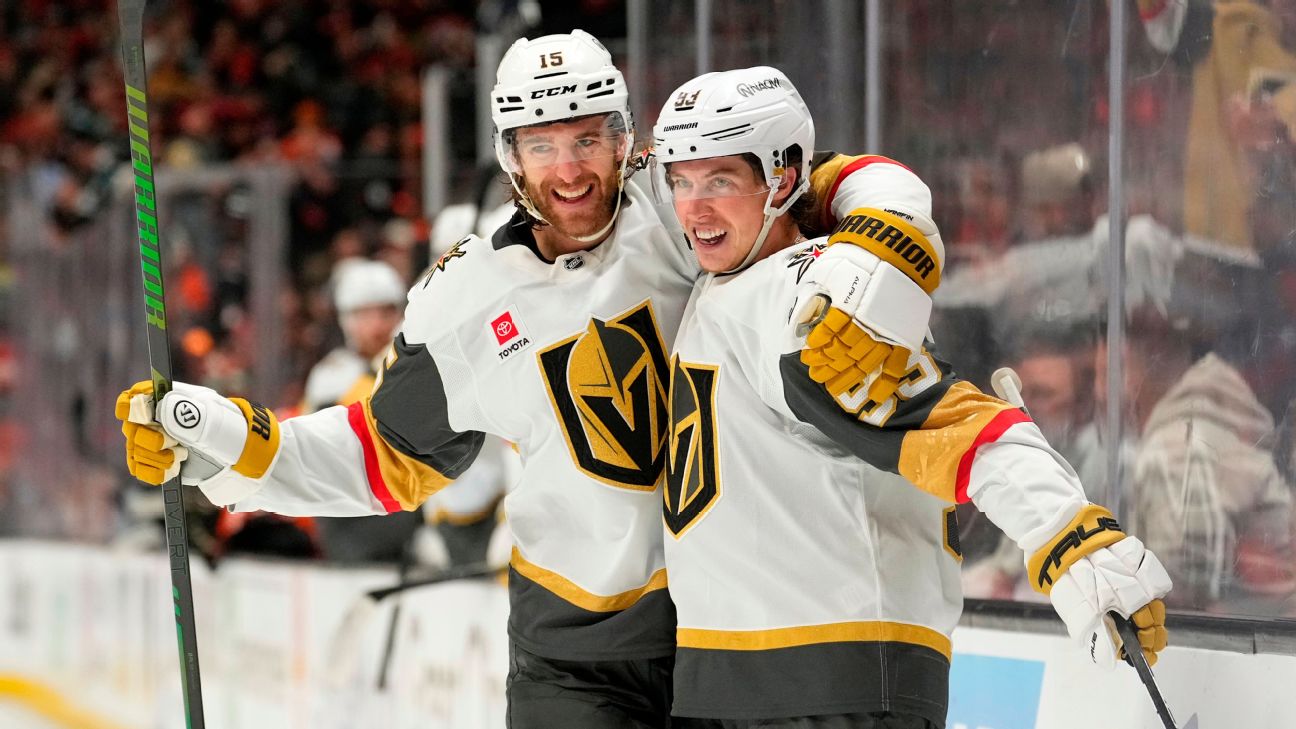
With unrestricted free agency looming, Marner and the Leafs parted ways last summer, when the Golden Knights acquired the wingerand signed him to a new eight-year contract that carries a $12 million AAV. Vegas is not Toronto when it comes to media and fan scrutiny. (I mean, what is?) So he escaped the Ontarian pressure cooker, exhaled for once and became the Golden Knights' playoff pacesetter after sputtering along during 70 postseason appearances for the Leafs.
Marner critics didn't even get to see him tormented by noted taskmaster John Tortorella when he took over the Golden Knights with eight games remaining in the regular season! The memes were everywhere, predicting a fragile star being broken by the league's most intense coach.
On the contrary, Torts loves "Mitchie," as he has referred to him to the media, and has pushed back against the narratives formed about him in Toronto.
"I think he's a hell of a hockey player. I think he's very confident in what he brings," Tortorella said after Marner's natural hat trick in Game 3 against the Ducks. "People give him s--- all the time about playoffs and this and that. I don't think it bothers him a lick. He just plays."
When asked about the narratives the next day, Tortorella said: "You guys don't see the stuff he does. People here, people in Toronto, all the people that talk about this guy, they don't see any of the things he brings to a game even if he doesn't score a goal. I've known that coaching against him. So, that narrative is a bunch of bulls---. Mitch doesn't care. Mitch is a pro. He's one of the top players in this league, and he plays for us."
Mitch Marner, thriving in the playoffs under coach John Tortorella. We'd say that's the most surreal Maple Leafs-related thing to happen in the past month, but then Toronto just hired John Chayka to replace Brad Treliving.
Lesson: Winning in the playoffs is a harsh education
Why have the Stanley Cup playoffs been so thrilling? I think part of it is the boundless enthusiasm of first-time participants.
The Buffalo Sabres ended a 14-season playoff drought. The Anaheim Ducks reentered the postseason for the first time since 2018, while the Philadelphia Flyers made it for the first time since 2020. The Pittsburgh Penguins were a playoff team for the first time since 2022 and had a roster of newbies behind the franchise standard-bearers such asSidney Crosby and Evgeni Malkin.
The Utah Mammoth made the playoffs for the first time in their existence -- and since The Franchise That Shall Not Be Named When Discussing The Mammoth (aka the Coyotes) hadn't made the playoffs since 2020, that's a whole bunch of first-time playoff voyagers on that roster.
If there was one overriding theme to the start of this year's playoffs, it was inexperienced teams and players figuring out how to win in the postseason. It's a harsh education, because the Stanley Cup playoffs are functionally a different sport from what's played in the previous 82 games.
"I just think it's a different style of game," said Trevor Zegras, who played 349 games in the NHL before making the playoffs with the Flyers this season. "Every series is a little different. The Pittsburgh series was a little more physical, more battles and a little bit more hatred, whereas the Carolina series was maybe a little faster, make more plays under pressure."
Zegras learned a lot about pressure over the last few weeks. "I just think the pressure of the games was something that you can't really prepare for. How you're going to feel when the puck drops for that playoff game," he said.
You could count on one hand the number of Flyers with previous playoff experience. You could almost do the same with the Sabres, which is why they ran into situations like Game 3 against the Canadiens. The lead slipped away. Bell Centre was popping. Tage Thompson said his team "got a little too emotional," including a parade to the penalty box that extended into Game 4.
That's why the approaches for Utah and Anaheim were intriguing. The Ducks balanced out their incredible generation of young talent by collecting players like Alex Killorn, who won multiple Cups with the Lightning; John Carlson, a Cup winner with Washington; and former New York Rangers Jacob Trouba and Chris Kreider, both with their own gravitas.
The Mammoth had multiple Cup winners in Mikhail Sergachev (Lightning) and Ian Cole (Pittsburgh), as well as Nate Schmidt, who won a Cup last season with the Panthers. GM Bill Armstrong told me that was by design to help his inexperienced players manage their emotions in the playoffs.
"We had some really good leaders that kind of stepped up and just said, 'Hey, you're going to feel like you're on top of the world, you're going to win the Stanley Cup, and the next night you're going to feel terrible. The world's fallen out,'" he told ESPN. "You've got to stay even-keeled in this process. And that's a huge thing not to get too up and down."
It was exhilarating to watch these teams learn in real time. Watching the Ducks figure out that possessing the puck means you don't have to figure out your defensive zone deficiencies. Watching Buffalo answer the bell when it seemed as if its series were on the brink of disaster. Watching the Flyers not freak out when Sid and the Penguins started to erase a 3-0 series deficit.
"It was such a good learning experience for myself and a lot of the other young guys that have never played a playoff game," Zegras said. "We know what to expect now."
Lesson: In the end, fans should choose joy
Philadelphia offered two of my favorite environments during the Flyers' run in the Eastern Conference.
The first was Game 3 against Pittsburgh, which was one of the most raucous and chaotic crowds in recent memory. The Flyers hadn't played a home playoff game since 2018. They were taking on their archrivals from Pittsburgh. The crowd was singing derogatory chants aimed at Sidney Crosby an hour before Crosby hit the ice and then throughout the game.
Gritty, in the mascot's first playoff appearance, threw a life-size stuffed penguin from the second level to the fans below, who crowd-surfed it while taking breaks to punch it in the face until an usher wrestled it away. It was pure, uncut Philly.
But so was what happened at the end of Game 4 against the Hurricanes, as Carolina completed the sweep. The game ended in overtime. Almost immediately, these passionate Philly fans -- whose passion, admittedly, can manifest in a variety of ways -- stood up and started loudly chanting "Let's go Flyers!" to numb their players' pain and acknowledge their accomplishment. It was one of the most touching things I can recall at the end of a series.
It even got to Rod Brind'Amour, who played nine years with the Flyers. As he shook Philly coach Rick Tocchet's hand, he pointed to the roof of the arena and told Tocchet to "take a minute" and soak in the love the fans were giving him and the team.
Look, not every elimination is going to be sunshine and rainbows, and not every fanbase is going to treat the end of a series like a curtain call of a Broadway show. But ... what if they did?
These are the 16 teams that earned the right to keep playing after the regular season. Win a round, and their team is still playing while three-quarters of the league is not. What's not to cheer, at least in the moment, as the reality of dashed expectations sets in.
I didn't have "Philadelphia fans as beacons of positivity in the face of defeat" on my bingo card, but here we are.
]
Related Topics
- SPORTS
- ESPN
- CHICAGO BLACKHAWKS
- EDMONTON OILERS
- NEW JERSEY-DEVILS
- FINLAND FINLAND
- PHILADELPHIA FLYERS
- LOS ANGELES-KINGS
- MINNESOTA WILD
- TORONTO MAPLE-LEAFS
- VEGAS GOLDEN-KNIGHTS
- WASHINGTON CAPITALS
- EASTERN CONF-ALL-STARS
- TEAM CHARA
- PITTSBURGH PENGUINS
- WESTERN CONF-ALL-STARS
- NASHVILLE PREDATORS
- CAROLINA HURRICANES
- USA USA
- SEATTLE KRAKEN
- WINNIPEG JETS
- ANAHEIM DUCKS
- TEAM LIDSTROM
- SWEDEN SWEDEN
- ST LOUIS-BLUES
- NEW YORK-RANGERS
- COLORADO AVALANCHE
- BUFFALO SABRES
- OTTAWA SENATORS
- COLUMBUS BLUE-JACKETS
- SAN JOSE-SHARKS
- FLORIDA PANTHERS
- TEAM STAAL
- DETROIT RED-WINGS
- NEW YORK-ISLANDERS
- TEAM ALFREDSSON
- UTAH MAMMOTH
- VANCOUVER CANUCKS
- NHL
- TEAM TOEWS
- TAMPA BAY-LIGHTNING
- BOSTON BRUINS
- DALLAS STARS
- MONTREAL CANADIENS
- CALGARY FLAMES
- TEAM FOLIGNO
- CANADA CANADA