ABC7 special 'Sex in Plain Sight' looks at rampant prostitution along LA's Figueroa Corridor



LOS ANGELES (KABC) -- Los Angeles is known around the world for being the home of Hollywood and having some of the world's best beaches, but it also has a much darker side.
There's a notorious hub for human trafficking just south of Crypto.com Arena and the Los Angeles Convention Center.
Criminal activity often happens in the shadows. Hidden so as not to draw the attention of passers-by, police or nosy neighbors.
On a stretch of the Figueroa Corridor, however, very little is hidden from view.
A four-mile section of Figueroa Street in South Los Angeles, from Gage Avenue to Imperial Highway, is well known for rampant prostitution. On nearly every corner, women in revealing outfits approach cars, day and night, out in the open, offering sex for a price.
This area has become known as "the Blade." Law enforcement officers, nonprofit advocates and survivors say it's one of the most dangerous hubs for human trafficking in the state.
It's fueled by a constant stream of customers and a lack of law enforcement resources to stop it.
"It is a huge, huge issue, and everybody should be extremely concerned," said Liz Armendariz, an LAPD officer and vice investigator for LAPD's 77th Division. "I just think, man, that is somebody's kid, and it's heartbreaking."
Vice units from the 77th patrol this section of Figueroa Street. We spent two nights with investigators, who showed us how they stop women from selling sex and perform age checks.
Our goal these days is not to arrest them. Our goal is to get them resources and the help they need to get out of their lifestyleLAPD Sgt. Navarro
If the person they stop is underage, she is brought back to the station, interviewed and turned over to the Los Angeles County Department of Children and Family Services. If the woman is over the age of 18, she is often released.
"There are men out there that have a taste for females and juveniles, and they know that they can find it. The pimp starts noticing, 'Hey, they want underage-looking people.' They're going to start recruiting underage people. The thing is that they're much easier to manipulate mentally because a lot of times they come from broken homes," said Navarro.
"Our goal these days is not to arrest them. Our goal is to get them resources and the help they need to get out of their lifestyle," he added.
Police tell us the pimps expect women working "the Blade" to earn hundreds of dollars a night.
"That's going to change girl to girl," Sgt. Navarro said. "It's going to be $600 to $800 to $1,200 a night."
We learned from our time out on "the Blade" and by talking to women who survived trafficking that the violence out there is extreme. That violence comes from the pimps, the sex buyers and the other girls and women working out there.
LA leaders want to crack down on human trafficking along Figueroa Corridor. What's their plan?
Gil Garcetti Learning Academy, a Los Angeles Unified School District elementary school, is just one block west of "the Blade."
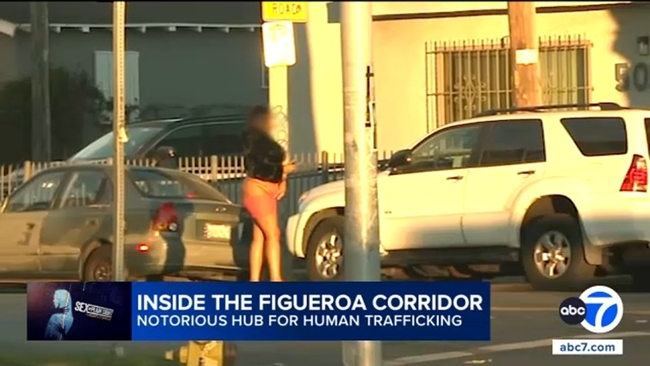
The school has placed green tarps over the fence that surrounds school grounds to block children from seeing the rampant prostitution.
"You can see the girls running around half naked," Elizabeth Garcia, a parent at the school told ABC7 On Your Side Investigates. "They literally stand in front of your car. They don't care if your kids are inside."
City leaders say ongoing enforcement efforts have struggled to keep up.
"It is difficult because it is like Whac-A-Mole," L.A. Mayor Karen Bass said. "You can crack down on Figueroa and now we have a problem in another part of the city, which is why it is important to go after the criminal enterprises, the traffic and to go after the johns."
L.A. County District Attorney Nathan Hochman said people selling sex along the corridor are often victims who face violence if they fail to meet quotas.
"We're going to go after the johns, these sex exploiters. And we're going to go after them not just with misdemeanor prosecutions, but felony prosecutions. In fact, we're also going to try and hopefully change the state laws as it pertains to these johns," Hochman said.
Hochman wants to punish the men coming to the corridor buying sex.
"Because it's a much more efficient way of dealing with the problem, is can we dry up the demand side?" he told ABC7 On Your Side Investigates.
Hochman even launched a public poll so county residents can vote on how they want him to punish the johns, such as seizing their vehicles or allowing sex work survivors to sue.
Going after the johns may be easier than targeting the pimps and traffickers.
"We have very unique complexities in human trafficking cases that do make our job hard," said Guillermo Santiso, head deputy district attorney for the Sex Crimes Division.
Santiso said it's difficult to get sex trafficking victims to cooperate.
"In the commercial sex lifestyle there's a term known as the game," Santiso said. "One of the fundamental concepts of the game is you don't snitch. You don't snitch against your trafficker."
Even though they may be tougher to prosecute, Hochman said he also wants to take down as many pimps as possible.
To make those arrests, he says he needs police to get more resources.
When you're sleeping, there's a 13-year-old girl who's just seen her ninth sex buyer of the day.LAPD officer Liz Armendariz
Victim advocate helps other women and girls after spending teen years in Figueroa Corridor
Los Angeles police tell Eyewitness News that some of the women you see wearing high heels and revealing outfits along "the Blade" are not adults at all.
"For some reason, we're conditioned to believe they are adults doing this willingly," said LAPD Sgt. Al Navarro.
"When you're sleeping, there's a 13-year-old girl who's just seen her ninth sex buyer of the day," LAPD officer and vice investigator Liz Armendariz said. "The youngest on Figueroa Street that I've rescued is a 12-year-old, and the youngest ever rescued along the Figueroa Corridor was 9 years old," Armendariz said.
"They are being bought and sold and traded and abused," Sara Elander said.
Elander works for the Los Angeles-based nonprofit Saving Innocence. She told ABC7 that Figueroa Street is one of the most violent corridors for human trafficking in the country.
Saving Innocence has helped nearly 2,000 trafficking victims in and around L.A. since 2010. The organization provides much-needed resources to women and girls who want to escape "the Blade".
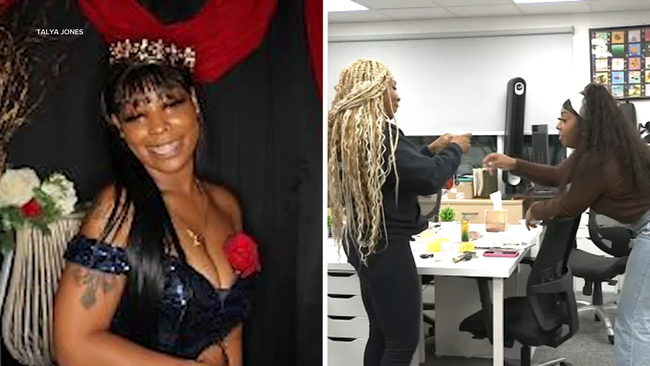
One of those trafficking survivors is Talya Jones. She now works with Saving Innocence after spending her teenage years on Figueroa Street. She ended up working "the Blade" after falling in love with an older man when she was just 13 years old.
"They call it boyfriend pimping," Jones, who is now 25, said. "So it was that type of older man attraction. I needed certain necessities. I wanted to be a teenage girl. I wanted to go out, hang out, a lot of parties, and hang out."
But in order to keep the relationship going, she was required to work "the Blade" and bring in money. If she didn't, there were consequences.
"That's where, I think, the physical abuse comes in, the psychological, the drug abuse," Jones said. "You're forced to stay up. It starts with like, sleep being deprived. You have to stay out."
Case workers with Saving Innocence kept in touch with Jones and helped her leave Figueroa Street when she was ready.
"Until men are unwilling to purchase children for sex, we are going to have this issue," Elander said.
The demand to buy sex, especially with children, is likely only going to grow. Traffickers know that major events like the World Cup, the Super Bowl, and the Olympics will increase business. All of those major events are coming to L.A. over the next few years.