'Ping Pong for Good' program helps seniors with Parkinson's, dementia build strength and community

LOS ANGELES (KABC) -- Seniors living with Parkinson's disease, dementia and other neurological conditions are finding renewed mobility and connection through an unlikely tool: ping pong.
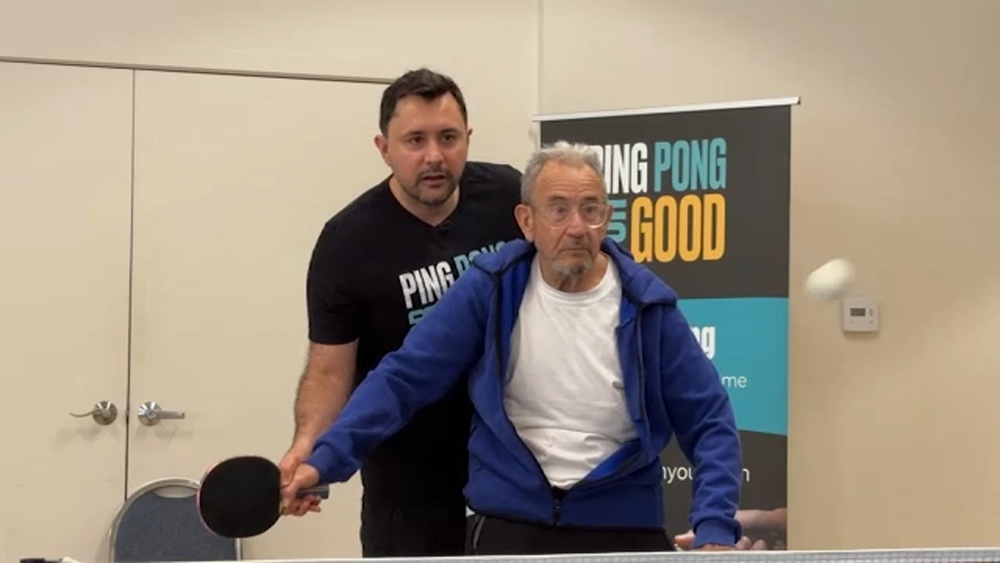
A local program called Ping Pong for Good is introducing older adults to the sport to improve balance, coordination and overall well being.
Maureen McComsey, the program's executive director, said she first recognized the benefits of table tennis after seeing its impact on a 92-year-old great grandmother.
"Once we realized that there was no mechanism to play safely, especially for the older populations and the people living with Parkinson's and Alzheimer's and other brain conditions, we got together some experts and then we designed a program to help make it safe, effective, and fun," McComsey said.
Alex Figueroa, head coach for the program, said ping pong challenges both the mind and body.
"Playing ping pong is like playing chess at a very high speed," he said. "Your brain is forced to react to different scenarios, balance and hand-eye coordination ... all type of complex coordination skills."
He added that improvements are often visible right away.
"I see progress in my students - most of the time I see it at the beginning of the session and at the end, and it's a completely different picture," Figueroa said.
For participants, the benefits extend beyond physical movement.
Farrel Levy, who has Parkinson's, said symptoms and medication side effects once kept her from staying active.
"I just really didn't feel like doing anything," she said. After attending a class held near her home, she felt an immediate lift. "By the end of the class, I was smiling, and I said, you know, I think I'd like to learn this more. What could go wrong? I mean, I feel better."
Writer Sharon Krischer runs a blog about living with Parkinson's and said she sees dramatic changes in fellow participants.
"I see people coming here who can barely move, and then they get a ping pong paddle in their hand, and all of a sudden, they can hit the ball ... they can do all these things that they didn't think they could do," she said. "It's been a blast. It's been a lot of fun. I've made great friends."
Levy said the program also helps her see the value in community.
"After class, we have become friends and we talk to one another about our meds and various things that are going wrong, and we welcome the opportunity to talk to other people with the disease," she said. "I think that's really, really helpful for everyone in the class."
McComsey said she hopes the program can expand.
"My dream is that this program can be available to everybody that can benefit from it," she said. "I would love to see ping pong tables with these vibrant programs happening at community centers, YMCAs, senior homes and gyms. Ping pong truly can transform lives."