Gov. Gavin Newsom signs redistricting plan to counter Texas' new congressional map

KABC logo
Last updated: Friday, August 22, 2025 1:28AM GMT
ABC7 Eyewitness News

Gov. Gavin Newsom signed California's new redistricting plan that could slash five Republican-held House seats to counter Texas' mid-decade redraw of its congressional map.

Lawmakers in the state Assembly and Senate approved the redistricting plan on Thursday afternoon.

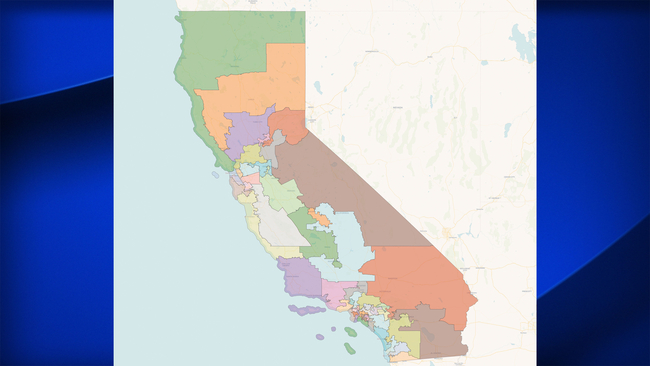
California Democrats introduced the plan last week that could slash five Republican-held House seats in the liberal-leaning state while bolstering Democratic incumbents in other battleground districts.

The move comes in direct response to efforts by Texas Republicans to redraw House districts in order to strengthen the GOP hold on the chamber in 2026. Texas Republicans passed a map creating five new winnable seats for the GOP in that state's House of Representatives on Wednesday.

The first draft of California's redrawn congressional district maps has been released.

However, unlike in Texas, the California seats cannot become official unless approved by the voters.

ByThe Associated Press AP logo
Aug 21, 2025, 5:00 PM

How redistricting is done and why it could give parties an edge in 2026 elections

As California and Texas scramble to redraw U.S. House maps before the 2026 midterm elections, the race is underlining redistricting's big role in determining political power.

Texas took action after President Donald Trump directed Republican-controlled states to change where the district lines are drawn based on where the population is likely to vote Republican - a practice known as partisan gerrymandering. California Democrats were poised Thursday to approve their redrawn congressional map in response.

Midterm elections often go against the president's party. Trump is trying to avoid a repeat of the 2018 midterms, when the GOP yielded control during his first presidency to a Democratic majority that stymied his agenda and twice impeached him.

The Texas maps next need approval from the GOP-controlled state Senate and Republican Gov. Greg Abbott's signature. They were drawn so Republicans could potentially pick up five seats in Congress.

The maps being considered by the California Legislature were drawn so Democrats could pickup five seats.

Here's what to know.

How is the number of US House members decided?

Each decade, the Census Bureau collects population data that is used to divvy up the 435 U.S. House seats proportionally among the 50 states. States that grew relative to others might gain a House seat at the expense of states in which populations stagnated or declined.

California and Texas, with the highest populations, have the highest number of representatives of all states.

Most states use their own rules and procedures to create the districts represented by each House member. The states with the lowest population numbers receive only one representative, which means the entire state is a single congressional district.

Americans can find their representative and see a map of their district on the U.S. House website.

What is gerrymandering?

The word "gerrymander" was coined in America over 200 years ago as an unflattering means of describing political manipulation in legislative mapmaking.

In states where lawmakers make the maps: If a political party controls a state's legislature and governor's office - or has such a large legislative majority that it can override vetoes - it can effectively draw districts to its advantage.

One common method of gerrymandering is for a majority political party to draw maps that pack voters who support the opposing party into a few districts, thus allowing the majority party to win a greater number of surrounding districts.

Another method is for the majority party to dilute the power of an opposing party's voters by spreading them among multiple districts.

Can district maps be changed anytime?

By the first midterm elections after the most recent population count, each state is ready with its district maps, but those districts don't always hold. Courts can find that the political lines are unconstitutional.

While some states have their own limitations, there is no national impediment to a state trying to redraw districts in the middle of the decade. The U.S. Supreme Court in 2019 ruled that the Constitution does not prohibit partisan gerrymandering to increase a party's clout, only gerrymandering that's explicitly done by race.

"The laws about redistricting just say you have to redistrict after every census," Doug Spencer, Rothgerber Jr. Chair in Constitutional Law at the University of Colorado, has said. "And then some state legislatures got a little clever and said, 'Well it doesn't say we can't do it more.'"

What is happening in Texas, California and in other states

Trump urged Texas to redraw maps to help the GOP, and his team has signaled that efforts could expand to other states, with a similar push underway in Missouri and Indiana. Ohio Republicans were already revising their map before Texas took action.

A new California map would need to be approved by voters in a special election in November because that state normally operates with a nonpartisan commission drawing the map to avoid the very sort of political battle that is playing out.

Democrats in Maryland and New York are mulling map revisions as well. New York, however, can't draw new maps until 2028, and even then, only with voter approval.

Democratic-run states have commission systems like California's or other redistricting limits more often than Republican ones do, leaving the GOP with a freer hand to swiftly redraw maps.

Democrats have also vowed to challenge the new Texas maps in court.

AP logo
Aug 22, 2025, 12:26 AM GMT

Gov. Newsom signs legislation calling special election on new map

California voters will decide in November whether to approve a redrawn congressional map designed to help Democrats win five more U.S. House seats next year, after Texas Republicans advanced their own redrawn map to pad their House majority by the same number of seats at President Donald Trump's urging.
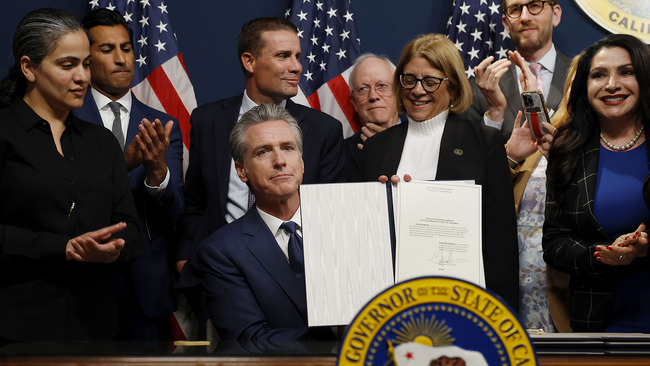
California voters will decide in November whether to approve a redrawn congressional map designed to help Democrats win five more U.S. House seats next year, after Texas Republicans advanced their own redrawn map to pad their House majority by the same number of seats at President Donald Trump's urging.

California lawmakers voted mostly along party lines Thursday to approve legislation calling for the special election. Democratic Gov. Gavin Newsom, who has led the campaign in favor of the map, then quickly signed it - the latest step in a tit-for-tat gerrymandering battle.

"We don't want this fight and we didn't choose this fight, but with our democracy on the line, we will not run away from this fight," Democratic Assemblyman Marc Berman said.

Republicans, who have filed a lawsuit and called for a federal investigation into the plan, promised to keep fighting it.

California Assemblyman James Gallagher, the Republican minority leader, said Trump was "wrong" to push for new Republican seats elsewhere, contending the president was just responding to Democratic gerrymandering in other states. But he warned that Newsom's approach, which the governor has dubbed "fight fire with fire," was dangerous.

"You move forward fighting fire with fire and what happens?" Gallagher asked. "You burn it all down."

In Texas, the Republican-controlled state Senate was scheduled to vote on a map Thursday night. After that, Republican Gov. Greg Abbott's signature will be all that is needed to make the map official. It's part of Trump's effort to stave off an expected loss of the GOP's majority in the U.S. House in the 2026 midterm elections.

A battle for the US House control waged via redistricting

On a national level, the partisan makeup of existing districts puts Democrats within three seats of a majority. The incumbent president's party usually loses congressional seats in the midterms.

The president has pushed other Republican-controlled states including Indiana and Missouri to also revise their maps to add more winnable GOP seats. Ohio Republicans were also already scheduled to revise their maps to make them more partisan.

The U.S. Supreme Court has said the Constitution does not outlaw partisan gerrymandering, only using race to redraw district lines. Texas Republicans embraced that when their House of Representatives passed its revision Wednesday.

"The underlying goal of this plan is straight forward: improve Republican political performance," state Rep. Todd Hunter, the Republican who wrote the bill revising Texas' maps, said.

On Thursday, California Democrats noted Hunter's comments and said they had to take extreme steps to counter the Republican move.

"What do we do, just sit back and do nothing? Or do we fight back?" Democratic state Sen. Lena Gonzalez said. "This is how we fight back and protect our democracy."

Democrats have sought a national commission for redistricting

Republicans and some Democrats championed the 2008 ballot measure that established California's nonpartisan redistricting commission, along with the 2010 one that extended its role to drawing congressional maps.

Democrats have sought a national commission that would draw lines for all states but have been unable to pass legislation creating that system.

Trump's midterm redistricting ploy has shifted Democrats.

That was clear in California, where Newsom was one of the members of his party who backed the initial redistricting commission ballot measures, and where Assemblyman Joshua Lowenthal, whose father, Rep. Alan Lowenthal, was another Democratic champion of a nonpartisan commission, presided over the state Assembly's passage of the redistricting package.

Newsom on Thursday contended his state was still setting a model.

"We'll be the first state in U.S. history, in the most democratic way, to submit to the people of our state the ability to determine their own maps," Newsom said before signing the legislation.

Former President Barack Obama, who's also backed a nationwide nonpartisan approach, has also backed Newsom's bid to redraw the California map, saying it was a necessary step to stave off the GOP's Texas move.

"I think that approach is a smart, measured approach," Obama said Tuesday during a fundraiser for the Democratic Party's main redistricting arm, noting that California voters will still have the final say on the map.

California's plan is temporary

The California map would last only through 2030, after which the state's commission would draw up a new map for the normal, once-a-decade redistricting to adjust district lines after the decennial U.S. Census. Democrats are also mulling reopening Maryland's and New York's maps for mid-decade redraws.

However, more Democratic-run states have commission systems like California's or other redistricting limits than Republican ones do, leaving the GOP with a freer hand to swiftly redraw maps. New York, for example, can't draw new maps until 2028, and even then, only with voter approval.

In Texas, outnumbered Democrats turned to unusual steps to try to delay passage, leaving the state to delay a vote by 15 days. Upon their return, they were assigned round-the-clock police monitoring.

California Republicans didn't take such dramatic steps but complained bitterly about Democrats muscling the package through the Statehouse and harming what GOP State Sen. Tony Strickland called the state's "gold-standard" nonpartisan approach.

"What you're striving for is predetermined elections," Strickland said. "You're taking the voice away from Californians."
KABC logo
Aug 21, 2025, 10:49 PM GMT

California State Senate approves redistricting plan

The California State Senate has approved Gov. Gavin Newsom's redistricting plan, which would redraw the congressional map to slash five Republican-held House seats.

The State Senate approved the redistricting plan in a 30-8 vote Thursday afternoon. This comes shortly after the California State Assembly's approval in a 57-20 vote.

The matter now heads to Newsom, who is expected to sign.

Thursday's passage triggers a special election in roughly two and a half months. This will be on the Nov. 4 ballot known as Prop 50.

The California State Assembly and Senate passed a redistricting plan to set a special November election on a new U.S. House map.
KABC logo
Aug 21, 2025, 9:17 PM GMT

Newsom raises $6.2M in 7 days since redistricting push

Gov. Gavin Newsom has raised $6.2 million in the last seven days from 200,000 donors, a spokesperson for his campaign confirmed to ABC News.

The fundraising number was first reported by the New York Times and comes a week after Newsom formally unveiled his push to have California put new congressional maps on the ballot in November, in retaliation for mid-decade redistricting in Texas.

KABC logo
Aug 21, 2025, 8:00 PM GMT

California State Assembly approves redistricting plan

The California State Assembly has passed a redistricting plan that could slash five Republican-held House seats. The plans will now head to the State Senate for another vote.

The assembly approved the redistricting plan in a 57-20 vote Thursday.